

Community choice aggregators (CCAs) and public power companies are scaling faster than ever—expanding their renewable portfolios, navigating dynamic wholesale markets, and managing diverse counterparties. Each new deal adds layers of data streams, pricing structures, and settlement terms that they must track, verify, and reconcile.
Much of this complexity stems from power purchase agreements (PPAs)—the cornerstone of renewable procurement. Spanning dozens of pages, these long-term contracts use detailed conditional logic to govern electricity pricing, delivery, and settlement.
Managing structured energy contracts at scale has become a significant operational challenge. What companies could once handle in spreadsheets or legacy systems now demands real-time integration, validation, and automation. Errors in a single formula or data feed can cascade into missed revenue, compliance issues, and strained relationships with counterparties.
That’s why leading organizations are moving toward integrated, automated systems purpose-built for structured energy contract management—software that can centralize data, model contract logic, and streamline settlement validation from end to end.
The shift isn’t just about efficiency; it’s about safeguarding accuracy, transparency, and trust in an increasingly complex energy marketplace.
The Growing Complexity of Energy Contracts
PPAs illustrate just how complex structured energy contracts have become—and why manual management is no longer a sustainable approach. They combine multiple data sources, time-dependent pricing models, and performance guarantees, creating layers of complexity that spreadsheets and legacy systems struggle to handle.
What Makes Structured Contracts So Challenging
Structured energy contracts have evolved in many ways, each introducing its own challenges. The following factors make settlements, validation, and invoicing increasingly difficult:
- Diverse Resources: Today's portfolios encompass a range of sources, including natural gas, solar, wind, hydro, nuclear, battery storage, and demand response. Each resource type has unique operating characteristics, contractual obligations, and settlement requirements, and demands careful tracking and reconciliation across the portfolio.
- Time-Dependent Pricing: Many contracts adjust prices by hour or season and may include curtailment provisions and performance incentives. Applying these terms accurately across multiple projects is crucial to ensuring that settlements accurately reflect actual performance and contractual commitments.
- Market Volatility and Rules Changes: CCAs and utilities operate across multiple Independent System Operator (ISO) markets, each with evolving tariffs, congestion rules, and settlement processes. Settlement teams must stay agile, constantly updating calculations and procedures.
- Complex Settlement Structures: Today’s contracts often cover energy sales, ancillary services, capacity, and renewable energy credits (RECs). Each product type demands unique validation and billing logic, adding operational complexity.
- Contract-Specific Customizations: No two PPAs are alike. Each contract may embed unique terms for penalties, availability guarantees, force majeure events, or incentive payments, requiring precise interpretation and application to avoid errors.
The Bottleneck Effect
Even with skilled teams, the practical challenges of managing complex contracts are significant. Manual methods and disconnected systems create bottlenecks and increase the risk of mistakes:
- Manual Processes Aren't Scalable: Spreadsheets and legacy tools require analysts to manually model contract logic, making them nearly impossible to scale.
- Data Is Siloed: Organizations often store contract, operational, and settlement data in separate systems, making reconciliation tedious and prone to errors.
- Settlements Are Hard to Verify: Shadow settlements, the process of validating ISO market settlements against complex contract terms, demand expertise and time. Without automation, costly discrepancies can go undetected.
- Invoicing Is Slow: Producing accurate invoices that reflect all contract details can take days or weeks, delaying revenue recognition and creating cash flow challenges.
- Dispute Resolution Is Challenging: Without clear audit trails, resolving discrepancies consumes a significant amount of time and resources.
The Risks of Inadequate Contract Oversight
Even small gaps in managing structured energy contracts can have major consequences. Missed settlement charges or under-billing can quietly erode revenue, while errors or omissions may create compliance exposure, potentially leading to fines, litigation, or reputational harm.
Inaccurate or incomplete data also limits your ability to optimize performance or implement risk-based pricing strategies. Without precise settlement records, negotiating or enforcing contract terms becomes significantly more challenging.
The bottom line is this: How well you manage structured energy contracts directly impacts your risk, cash flow, and market competitiveness.
Why Automation Is Essential
Automation enables companies to manage growing contract complexity with greater accuracy, speed, and scalability—capabilities that manual processes and spreadsheets simply can’t match. In today’s fast-moving energy markets, automation has become essential to maintaining both precision and agility.
Yes Energy’s ContractCoreTM delivers these capabilities in a platform purpose-built for the energy sector. It centralizes operational, contractual, and settlement data, applies configurable logic for diverse contract types, and integrates seamlessly with energy trade risk management (ETRM) and financial systems. With unified workflows and automated validation, ContractCore enables teams to manage every agreement, milestone, and settlement with accuracy.
Key capabilities include:
- Comprehensive Integration: You have full visibility and control across all operational, contractual, and settlement data.
- Configurable Logic: This solution accommodates diverse contract types and custom agreements, from PPAs and EMAs to tolling and transmission deals.
- Automated Validation and Invoicing: Our solution streamlines shadow settlements, identifies discrepancies, and automates billing with defensible data.
- Transparency and Auditability: You get real-time dashboards, exception reporting, and clear audit trails that strengthen oversight and counterparty confidence.
- Scalability: This enables portfolio expansion without proportional increases in back-office staff.
Case Studies: Real-world Impact
Organizations using ContractCore have seen dramatic improvements in both efficiency and accuracy.
Marin Clean Energy (CA) reduced invoice validation times from four to five hours to under 10 minutes per invoice by automating data integration and settlement workflows through ContractCore.
Similarly, Arizona Public Service (AZ) leveraged ContractCore to shorten its quarterly contract management and invoicing cycle from five to eight business days to less than one—a 90% time improvement.
An Ecosystem Built for Success
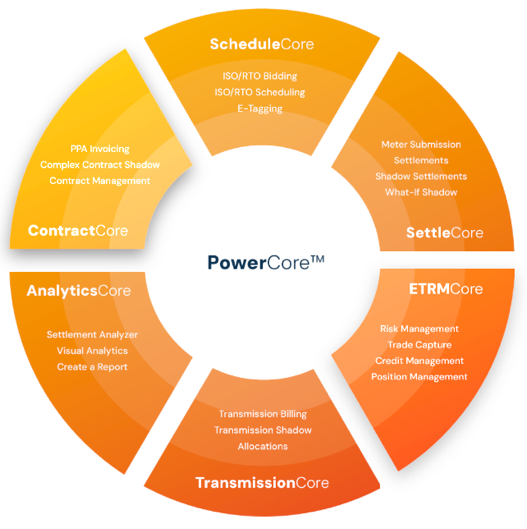
ContractCore is one module within the broader Yes Energy PowerCore platform, an end-to-end, cloud-based solution designed to help energy organizations operate with greater efficiency, visibility, and confidence. PowerCore supports a wide range of supply and trading operations, providing advanced tools for bidding, scheduling, settlements, and analytics, all while adapting to evolving market rules and workflows.
Source: Yes Energy
The platform is organized into flexible, modular components to meet the needs of different market participants:
- ContractCore: Centralizes contract administration, validation, and invoicing for structured agreements.
- ETRMCore: Supports trade capture, risk management, and financial settlement processes.
- TransmissionCore: Optimizes transmission billing, settlement, and allocations using complex calculation methods, integrating essential operational data, and disaggregating charge code amounts to cost-causing assets.
Additional modules—AnalyticsCore, ScheduleCore, and SettleCore—are available in select ISOs, primarily in western markets such as WEIM, CAISO, SPP IM, and parts of MISO.
By integrating these modules into a single ecosystem, PowerCore enables utilities, CCAs, and power traders to navigate market complexity with precision, respond quickly to operational and regulatory challenges, and maintain visibility across every aspect of their portfolios. In an era of expanding renewable energy adoption and increasingly complex contracts, this ecosystem provides a foundation for efficient, accurate, and scalable operations.
Contact us to discover how ContractCore can modernize your settlement operations and help your team manage complexity with confidence.

Meet the Author