


Explore a winter 2026 power market outlook for the Electric Reliability Council of Texas (ERCOT), based on Yes Energy’s and Horizons Energy’s data. Examine projected changes in load growth, firm capacity, and reserve margins from 2026 to 2031.
Together, these insights provide context for anticipated trends in ERCOT market conditions and longer-term planning considerations.
ERCOT Load Growth Forecast
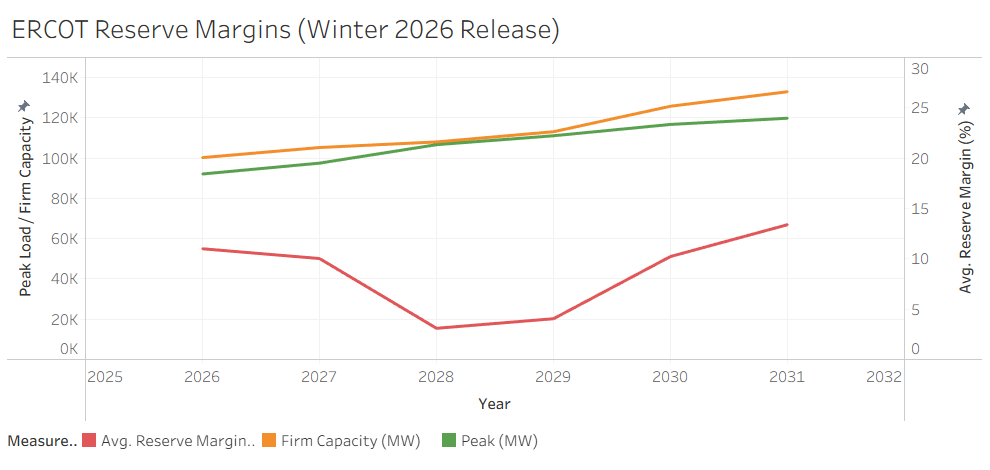
Our Winter 2026 Reference Case Forecast projects that peak load will grow from 90 GW in 2026 to 117 GW in 2031, while firm capacity will increase from 100 GW to 133 GW over the same period.
We project that ERCOT will stretch its current capacity expansion plans to meet load growth, resulting in single-digit reserve margins in 2028 and 2029. After 2029, we expect that generation will catch up with demand, and reserve margins will stabilize.
Our load projections are already lower than ERCOT’s. We assume that 50% of the Contract and Officer Letter Loads that ERCOT included in its Adjusted Load Forecast won’t materialize.
Horizons Projected ERCOT Summer Firm Capacity and Peak Load, 2026 to 2031
Source: Yes Energy’s GridSite and Horizons Energy
Capacity Coming Online
Although substantial nameplate capacity is expected to come online, much of the new solar generation doesn’t contribute to firm capacity. This is because of peak demand hours shifting into the evening, when solar output is minimal.
Most of the increase in ERCOT firm capacity comes from natural gas combined cycle and combustion turbine plants, along with energy storage.
Texas has one of the fast-growing battery energy storage system markets in the US. After ERCOT implemented RTC+B recognizing batteries not as separate charging and discharging assets but as unified energy storage resources, batteries are poised to continue to boom and to impact the market.
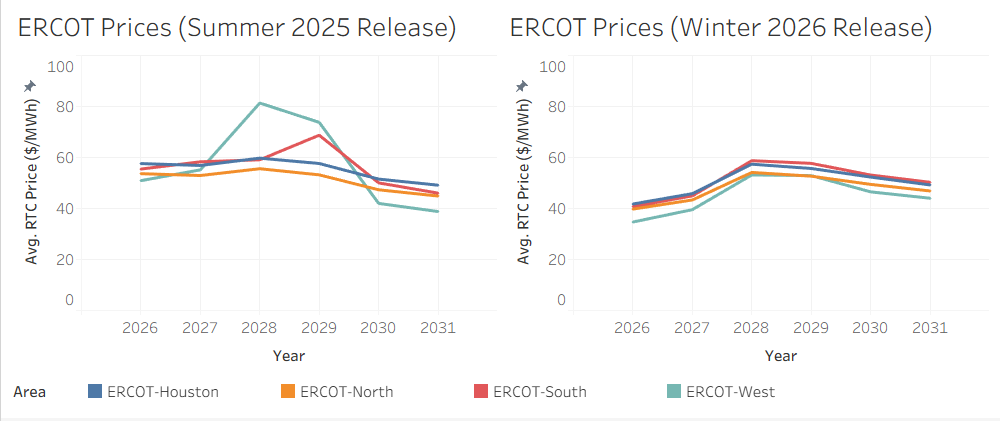
Our Winter 2026 Reference Case Forecast projects lower prices and reduced interzonal basis compared to our spring 2025 release. This is driven by relaxed assumptions around the timing of announced resource additions, reflecting the current push to bring projects online ahead of PTC expiration.
ERCOT Forecast Zonal Annual Average LMPs, 2026 to 2031
Source: Horizons Energy and Yes Energy’s GridSite
Conclusion
The Winter 2026 Reference Case Forecast highlights continued ERCOT load growth alongside expanding firm capacity. Compared to the previous release, updated assumptions around resource timing contribute to lower projected prices and reduced interzonal basis. Together, these findings illustrate how evolving supply, demand, and storage dynamics may shape ERCOT market conditions over the next five years.
To get more information about nodal and zonal forecast prices, explore Yes Energy’s GridSite solution. GridSite includes hourly nodal and zonal-level price forecasts and detailed assumptions for a reference case and four sensitivities through 2050. It combines this forecast with deep historic pricing and interconnection queue data to power market participants to make smarter long-term planning and investment decisions.
To dive deeper into our look at historic ERCOT trends and future predictions, get the white paper, Historical ERCOT Pricing and Drivers: An Analysis.
To see GridSite in action, request a demo.

Meet the Author



.png?width=380&name=2719005_FY26Q1DownloadableAssetEmailGraphics-Due3-06_WhiteTopColorBottom02_030426%20(1).png&format=auto&upscale=false)