

Navigate SPP RTOE with a Trusted Partner
Schedule your demo today to see how our power market data solutions help you remain ahead.
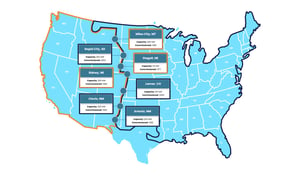
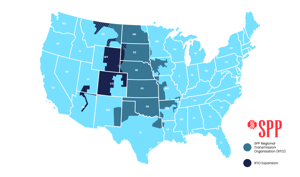
The Southwest Power Pool (SPP) will launch its RTO Expansion (RTOE)—one of the most significant structural changes in US wholesale power markets in recent years.
The initiative expands SPP’s Regional Transmission Organization into the Western Interconnection, making SPP the first RTO to operate organized wholesale markets across both the Eastern and Western interconnections.
For market participants across the region, the expansion represents more than a geographic shift. It introduces new pricing nodes, additional trading opportunities, and changes to how data is published—while also increasing complexity across market participation, settlements, and operational workflows.
We've supported SPP market participants since 2008, helping teams adapt through every major redesign. Here are some of the ways we'll help you navigate this change:
Market leadership
For more than 15 years, SPP participants have relied on our expertise through major market changes—supporting both market understanding and evolving operational demands. We’re focused on always providing trusted data and insights.
Quality data
As a leader in power market data and analytics, we empower customers with access to the latest SPP RTOE information —including new nodes, pricing, and system conditions— to inform short- and long-term decisions.
Expert support
Our team provides ongoing guidance, resources, and hands-on support so you can adapt quickly and confidently—whether you're analyzing market conditions or managing operational processes.
Support across the bid-to-bill lifecycle
From market activity through settlements and invoicing, we help utilities and market participants navigate the increasing complexity of RTO participation and reduce manual, cross-system effort.
Join Yes Energy experts for a detailed look at what’s changing and how your workflows and data will evolve.
Market participant in SPP? Here's what you should be aware of as the market transitions.


You can find out more information by going to the Yes Energy help system (Yes Energy login required). You can also reach out to your dedicated account manager or support@yesenergy.com.
The East BAA, reported by the ISO as “SPP,” maps to an existing Yes Energy objectID= 10017060648 (name= ‘SPPISO-East’). The West BAA, reported by the ISO as “SWPW,” maps to an existing Yes Energy objectID= 10019234935 (name= ‘SPPISO-Westt’).
The MECs will relate to each other based on the status of the West DC Ties connecting the two BAAs. When the DC Ties have available capacity (unconstrained), SPP’s single market optimization will simultaneously determine flows and dispatch across both networks. The same marginal resource influences the marginal cost to serve the load in both BAAs.
If the DC ties have no available capacity (constrained), SPP's single market optimization will economically stop scheduling power to flow across the interconnections, the MEC will decouple, and the market optimization will find the generator from each specific BAA to serve the next increment of load.
Though SPP will calculate separate Marginal Energy Components (MEC) for the East and West BAAs, the two will often be economically linked. The 310 MW limited capacity of the two DC Ties is expected to be a frequent constraint.
For many reports (wind/load forecasts, fuel mix, etc.) SPP is no longer posting the system-wide object and is just posting the data at the BAA level (called SPPISO-East and SPPISO-West in our products). Yes Energy plans to preserve the SPPISO object for continuity purposes by summing “SPPISO-East” (objectID= 10017060648) and “SPPISO-West” (objectID= 10019234935) post cutover. An SPPISO object (i.e. an ISO-wide object) is preserved for all “actuals” data. The system-wide object specific to forecast data is being worked on by our development team and will be available by the end of the day (March 31). Note, this means that before April 1, 2026, the SPPISO object will show data for SPP East, and after April 1, 2026, the SPPISO object will show data for East + West. Visit the Help System for additional details.
The SPP RTOE data is available under the existing SPP Trading Region subscription in Yes Energy.
Yes.
SPP coordinates structured and unstructured testing within its Member Test Environment (MTE) before large market design changes that involve executing specific base-case scenarios to simulate actions that will occur in the new settlements process.
The purpose of the MTE for the RTO Expansion is to run SWPW simulations to enable SPP, Transmission Customers (TCs), and Transmission Owners (TOs) to practice, validate, and refine the processes and systems intended for the RTOE before its production launch. We use this test data to make sure we are collecting and ingesting the format of the new reports accurately.
The new West Hub will have many fewer wind resources in its supply stack than SPP East. Therefore, SPP West is expected to have a real-time price premium over the North and South Hubs, leading to fewer prolonged low-price periods than the East. RTOE will create economic opportunity for SPP East wind resources by spreading wind generation across a larger area, allowing SPP to reduce local curtailment (albeit limited by DC tie capacity). A new Western Trading Hub facilitates better hedging against wind-driven negative prices in the expanded footprint.
The primary page for SPP RTOE on the SPP website is https://www.spp.org/western-services/rto-expansion/.
No. However, you should be aware of the SPP's mechanism for managing market power, which involves "Frequently Constrained Areas" (FCA). When an FCA is binding, energy offer curves are capped at 17.5% above the mitigated energy offer curve prices.
Due to the limited transfer capability across the DC ties, we can expect all resources in SPP West to qualify as pivotal suppliers, unlike SPP East where this binds for a small minority. SPP West resources will face a binding FCA, capping energy offers at 17.5% above mitigated prices. The high shift factors in SPP West indicate that even smaller resources will significantly impact specific flowgate constraints due to their substantial locational load weighting.
SPP will continue to utilize its market optimization, but will now be used to manage the asynchronous flow across the West DC Ties to dispatch the most economical resources for East and West BAAs using a single market optimization process. Each West DC Tie will be modeled in the market software as a linked withdrawal/injection pair joining the two BAAs.
The Security Constrained Unit Commitment (SCUC) will optimize the direction of the flow across the ties. Subsequently, the Security Constrained Economic Dispatch (SCED) will determine the optimal volume of the flow.
PSCO's service territory will be almost entirely contained within the expanded SPP footprint, making its monitoring important.
PSCO Interface location is an aggregate settlement point representing the weighted average of multiple interconnection points. Therefore, not all adjacent points of delivery will settle at this interface price. Virtual bidding/offering on the interface settles at this aggregate price.
A key dynamic to watch is the impact of transmission congestion on individual paths that make up the aggregate interface pnode. If the lines into PSCO become constrained, the PNodes on the SPP side of the border will likely experience a lower (or negative) Marginal Congestion Component (MCC). Simultaneously, the "internal" PSCO price will remain high, though this internal price cannot be traded directly in SPP.
The Security Constrained Unit Commitment (SCUC) will optimize the direction of the flow across the ties. Subsequently, the Security Constrained Economic Dispatch (SCED) will determine the optimal volume of the flow.
Market participants will have to decide between participating in CAISO EDAM/EIM, SPP Markets+, or SPP ISO. Customers cannot participate in both CAISO EDAM and SPP or CAISO EDAM and SPP Markets+.
Correct, physical e-tagging will no longer occur across the ties and will be scheduled from market optimization.
No, the Transmission Congestion Rights (TCR) auction has not yet happened for the SPP RTO Expansion area in the West.
The first TCR auction reflecting the RTO Expansion data will be the Annual TCR auction, with results published on May 22, 2026. Internal SPP East’s source-to-sink paths will operate like SPP TCR market but with a distinct nomination cap reflecting system capabilities. Cross-DC Tie allocation will transition over the first four years, automatically awarding rights to existing holders for stability. After this period, TCR participants can nominate and allocate cross-interconnection paths like any other source-to-sink path, meaning economic bids for these paths won't be reflected in TCR market data for four years.
The TCR market rules will remain consistent for paths that are contained in each BAA. The nomination cap will be set by SPP West capabilities, sharing the standard business-as-usual procedure for TCRs as SPP East operations.
However, the source-to-sink paths that cross the DC ties will undergo a four-year transition period. During this time, congestion hedging will be based on long-term Transmission Service Rights (TSRs) and settled as an option. The holders of these rights will be automatically awarded. So we will not have offer/bid data for these specific paths that will not reach the TCR market until after the four-year transition period.
Yes, LMP data for nodes in the West will be available to market participants in the East for ARR/TCR purposes.
The SPP West footprint and three internal DC ties will first show up in the annual ARR allocation process, which opens on April 1, 2026. RTO Expansion-related FTR data will first show up in the Annual TCR/FTR auction (results published May 22, 2026).
Physical trading based on e-tags is no longer permitted for sinks or sources located within the SPP West Balancing Authority Area.
Bilateral trades that were previously path-based are now converted into financial arrangements that settle against the DA or RT LMP.
SPP West market participants can submit DA bids and offers, with settlement based on the LMP difference. Any deviations in real time will settle at the RT LMP.
Yes, there are approximately 298 new tradable nodes in SPP West. They will be virtually traded exactly how SPP East is traded today.
There are approximately 300 new tradable nodes in SPP West.
There are about 298 new tradable virtual nodes for SPP West. These nodes will be tradable in the virtual market March 31 for the first operating day April 1. The new tradable nodes for SPP West can be found here: https://portal-mte.itespp.org/pages/da-lmp-by-settlement-location (filter BAA=SWPW).
The new tradable virtual nodes for SPP West can be found here: https://portal-mte.itespp.org/pages/da-lmp-by-settlement-location
Yes, there are approximately 298 new tradable nodes in SPP West. They will be virtually traded exactly how SPP East is traded today.
Schedule your demo today to see how our power market data solutions help you remain ahead.