
.png?width=300&name=Blog%20Header%20Image%20(5).png)
Summary
Starting April 1, 2026, SPP will extend its RTO into the Western Interconnection, which will bring new market participants, new trading opportunities, and new market dynamics. Here’s what it means, and how Yes Energy is preparing customers for day one of this expanded RTO.
Southwest Power Pool (SPP) will launch its RTO Expansion (RTOE)—one of the most significant structural changes in US wholesale power markets in recent years on April 1, 2026. The initiative expands SPP’s Regional Transmission Organization into the Western Interconnection, making SPP the first RTO to operate organized wholesale markets across both the Eastern and Western interconnections.
For market participants across the region, the expansion represents more than a geographic shift. It introduces new pricing nodes, additional trading opportunities, and changes to how data is published within the SPP Integrated Marketplace.
Expanding the SPP Market Footprint
As of SPP’s market notice on March 12, 2026, SPP affirmed its plans to proceed with expanding its RTO into the Western Interconnection. SPP’s RTO Expansion brings seven Western utilities and power entities under the SPP tariff and market structure, including:
- Basin Electric Power Cooperative
- Colorado Springs Utilities
- Deseret Power Electric Cooperative
- Municipal Energy Agency of Nebraska
- Platte River Power Authority
- Tri-State Generation and Transmission Association
- Western Area Power Administration
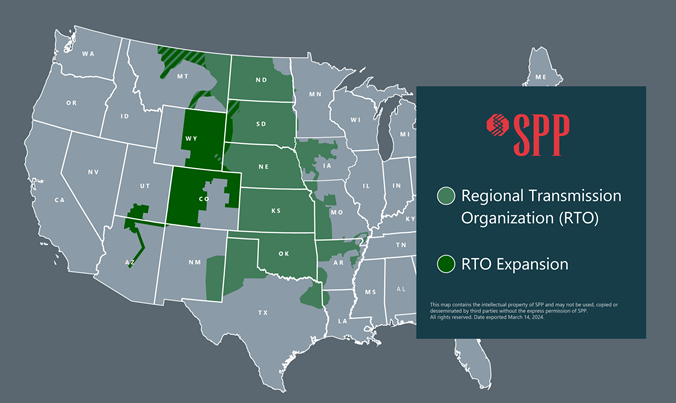
Source: SPP
With these additions, the expanded market will operate as two balancing authority areas (BAAs): SPP East and SPP West. These regions will be connected by three direct-current (DC) ties—Miles City, Stegall, and Sidney (shown in orange below)—which will allow power to flow between BAAs and be optimized by SPP.
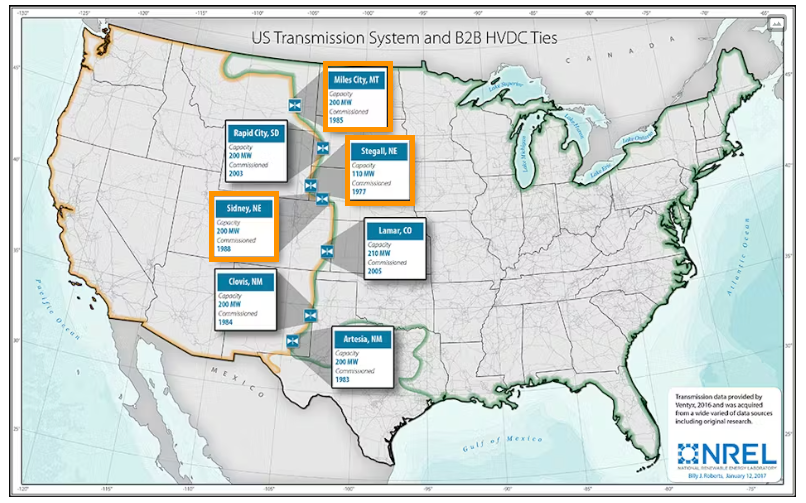
Source: NREL
Introduction of East and West BAAs
SPP will introduce a new Western balancing authority area (BAA), separate from its existing Eastern BAA, with both operating within the same Integrated Marketplace.
Prior to this expansion, SPP has operated primarily as a single BA within the Eastern Interconnection. This East BAA encompasses the "legacy" footprint of SPP. It’s composed of several Balancing Authorities (BAs) that were merged into the SPP Consolidated Balancing Authority (CBA), including American Electric Power West (AEPW), Nebraska Public Power District (NPPD), Oklahoma Gas & Electric (OG&E), and Kansas City Power & Light (KCP&L), etc.
Pairing two distinct BAAs—the pre-existing East BAA and the new West BAA—under a single BA is a specific feature of SPP’s RTO Expansion. The RTO Expansion, effective April 1, 2026, will operate as both an RTO and a single BA that manages the load-generation balance across its footprint encompassing two separate BAAs.
The West BAA will incorporate entities currently participating in its Western Energy Imbalance Service (WEIS) market as well as other entities previously operating outside of an RTO. SPP RTOE will provide a day-ahead market, reliability coordination, and other RTO services to these Western Interconnection participants, expanding upon the real-time imbalance service previously provided by WEIS. SPP RTOE will also introduce a new reference bus and a Western trading hub, enabling locational marginal prices (LMPs) to form independently for the West while remaining integrated with the broader SPP market.
For traders, analysts, and asset operators, this means more nodes, more transmission paths, and additional settlement components tied to flows across the DC ties. SPP has indicated that dozens of market and settlement reports will be updated to accommodate the expansion, including new fields identifying the relevant balancing authority area.
What Does This Mean for WEIS Participants?
SPP RTOE creates an opportunity for WEIS participants to leave the real-time balancing market that is WEIS and join an RTO. The benefits of joining an RTO are more certainty and opportunity. In contrast to the real-time balancing market WEIS, the SPP RTO includes a day-ahead market, co-optimization of energy and ancillary services, additional revenue streams (ancillary services), broader participation across a larger geographic footprint, and improved price transparency.
WEIS participants are not forced to join SPP RTOE. They have the choice of either staying in WEIS, joining CAISO EIM, or joining SPP Markets+. The graphic below provides a timeline of when markets like SPP RTOE are launching, when markets like WEIS are retiring, and how many market participants are leaving/joining each market.
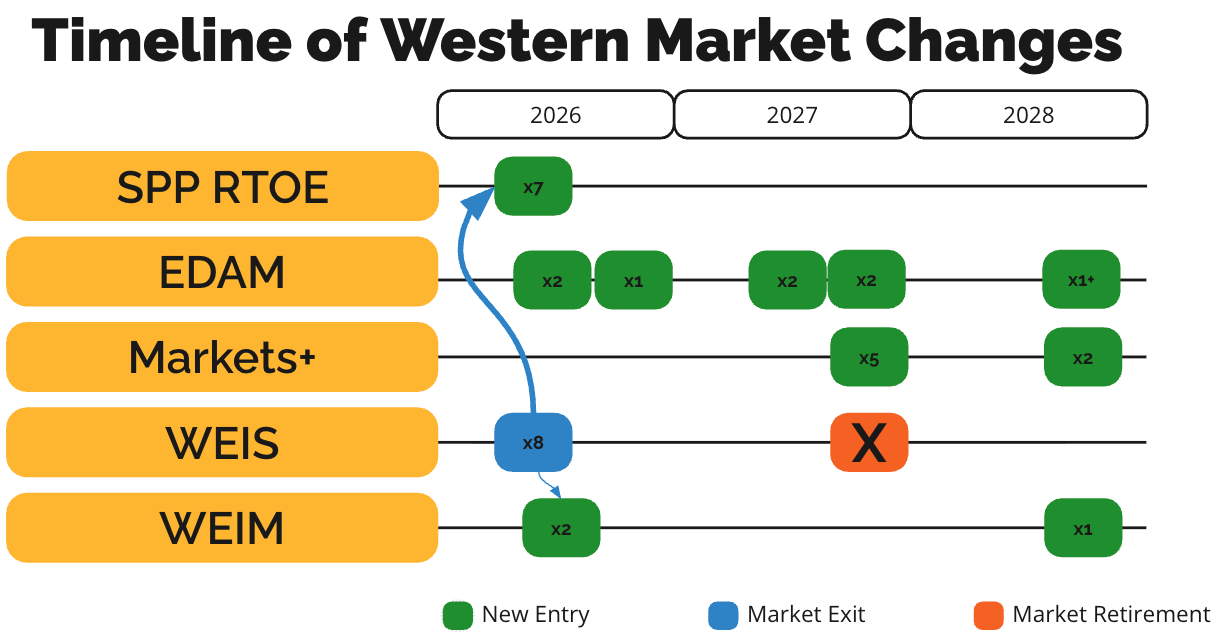 Source: Yes Energy
Leaving WEIS to Join SPP RTOE (Timeline: April 1, 2026)
As of March 2026, the following market participants have declared their plans to leave WEIS:
- Basin Electric Power Cooperative
- Colorado Springs Utilities
- Deseret Power Electric Cooperative
- Municipal Energy Agency of Nebraska
- Platte River Power Authority
- Tri-State Generation and Transmission Association
- Western Area Power Administration
Leaving WEIS to Join CAISO WEIM (Timeline: 2026)
- Black Hills Power
- Cheyenne Light, Fuel and Power
Preparing for the New Market
The SPP RTO expansion will affect nearly every part of market operations in SPP—from pricing to settlements—so market participants need to be ready when these changes take effect on April 1.
To support our customers through this transition, Yes Energy has been hard at work ensuring that our data pipelines and products are ready to handle this market change. Our Data Engineering team has been updating our existing SPP data collections to account for changes to existing reports, for example the introduction of a new BAA column in the LMP reports to delineate between settlement nodes in the East versus West Interconnection. Our Power Infrastructure team has been hard at work mapping the new price nodes and transmission elements so that LMPs, ancillary service prices, transmission outage data, and constraint data flow seamlessly into our products at go-live.
Test Data for Real-time, Day-ahead Markets
Since February, Yes Energy has been collecting test data from SPP’s Member Test Environment (MTE) ahead of the April 2026 launch so customers can explore how prices, congestion, and ancillary service markets may behave within the expanded footprint of SPP.
Yes Energy customers can access test data like real-time (RT) and day-ahead (DA) LMPs by settlement location and RT and DA market clearing prices (MCPs) for ancillary services in our user interface, API, and Snowflake products, making it easy for customers to incorporate the data into existing workflows prior to go live.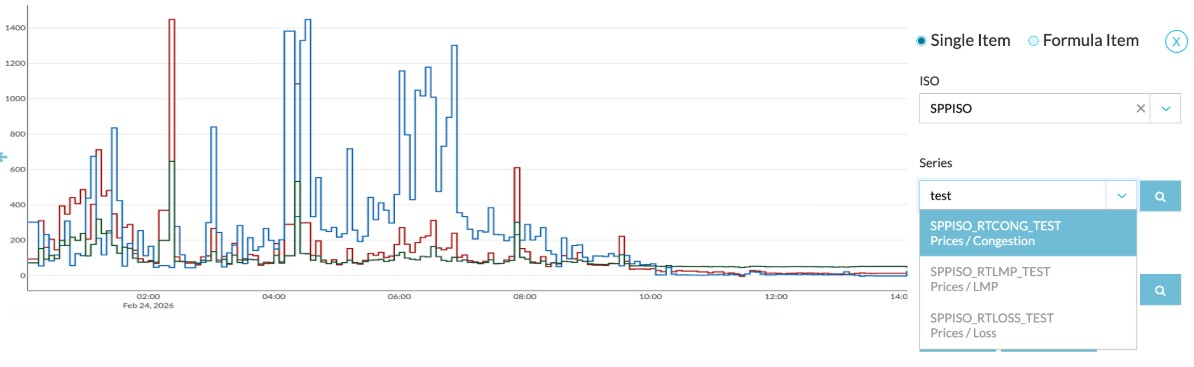
Source: Yes Energy
Virtual Portfolio Submission
Lastly, Yes Energy has been working with our Submission Services customers to connect them to SPP test environments, so they can submit their virtual portfolios seamlessly when SPP RTOE goes live on April 1. We have also completed the necessary API and certificate updates to ensure submissions function properly at go-live.
Ready for Day One
As the April 1 launch of the SPP RTO Expansion approaches, market participants across the region are preparing for a larger and more dynamic RTO. By expanding into the Western Interconnection, SPP is opening the door to broader participation across the grid.
Yes Energy will continue to monitor the rollout of SPP RTO Expansion and provide customers with the data and tools they need to operate in the expanded SPP market from day one.
Want to learn more about SPP RTOE? Register for Yes Energy’s upcoming webinar SPP RTOE: Market Impacts and Yes Energy Updates on March 26 at 1 p.m. ET.
Meet the Author