

Natural gas plays a central role in the American power grid, accounting for 43.1% of all utility-scale electricity generation and far outpacing coal (16.2%), nuclear (18.6%), and even the rapidly growing renewables sector (21.4%).
Let’s explore the current state of the country’s natural gas fleet, how it’s evolving, and what the future holds for gas-fired generation through the end of the decade.
How Do Natural Gas Plants Work?
Natural gas power plants generate electricity by burning fuel to create high-temperature gases or steam that spin a turbine. The turbine drives a generator, converting mechanical energy into electricity.
There are four primary types of natural gas plants in the US, each with its own design, efficiency profile, and operational role within the electric grid.
Typically, gas-fired units operate for 20 to 50 years, depending on the plant type.
Combined-Cycle Gas Turbine (CCGT) Plants
CCGTs are the workhorses of the natural gas fleet, representing the majority of the country’s gas-fired generating capacity, as shown above. They operate in two stages:
- Natural gas combusts in a gas turbine, generating electricity.
- Then, waste heat from the first stage is used to boil water, producing steam that drives a turbine to generate additional electricity.
This two-step process dramatically improves efficiency, enabling modern CCGT plants to reach thermal efficiencies of up to 60%, nearly double that of typical nuclear or coal plants. Higher efficiency also translates into lower emissions per megawatt-hour.
CCGTs are commonly used for baseload and intermediate loads. Their ability to ramp up or down quickly makes them ideal for balancing supply and demand fluctuations and ensuring grid reliability, which is critical as more intermittent renewable resources join the grid.
Simple-Cycle Gas Turbine (SCGT) Plants
SCGTs combust natural gas to produce electricity but do not recover waste heat, resulting in lower thermal efficiencies, typically 33% to 43%.
Though they are less efficient and more costly to operate, SCGTs provide fast, dispatchable power within minutes. They are ideal “peaker” plants as they can meet sudden spikes in electricity demand—such as on hot summer afternoons when air-conditioning use is high.
Steam Turbine (ST) Plants
In ST plants, natural gas burns in a boiler to produce steam that drives a turbine to generate electricity. Many ST plants were converted from coal-burning units as part of early decarbonization strategies. While these plants once provided baseload power, many older ST plants are being retired because, with efficiencies often as low as 20%, they lag behind modern SCGTs and CCGTs.
Reciprocating Internal Combustion Engine (RICE) Plants
RICE plants use large piston-driven engines—similar to those found in vehicles—to generate electricity by burning natural gas.
Although they represent just 1% of total US gas-fired capacity, their fast start-up times and flexibility make them valuable for backup power, emergency support, and quick grid balancing, especially in systems with a high share of intermittent renewable energy. Single-cycle RICE plants have an efficiency rate of 50%, but when they are used as part of a cogeneration or combined cycle plant, those rates can reach 90%.
The Current Landscape
Whether powering major urban centers or backing up intermittent solar and wind resources, gas-fired plants are deeply embedded in the US power grid. As of April 2025, approximately 1,200 natural gas power plants operate across the country.
Natural Gas Share of Installed Generating Capacity (2025)
|
Region |
% Gas-Fired Capacity |
|
New York ISO (NYISO) |
63%* |
|
ISO-New England |
|
|
Southwest Power Pool (SPP) |
|
|
Pennsylvania-New Jersey-Maryland (PJM) |
45%** |
|
Electric Reliability Council of Texas (ERCOT) |
|
|
Midcontinent Independent System Operator (MISO) |
|
|
California Independent System Operator (CAISO) |
*NYISO generation capacity as of June 23, 2025. Includes 22.79% natural gas and 40.28% dual fuel (power produced by facilities capable of using natural gas and/or other fossil fuels).
**PJM generation capacity as of June 23, 2025.
Recent Trends
In recent years, gas plant retirements have outpaced new capacity construction—a trend that may be changing.
In 2024, for example, only one industrial sector CCGT power generator came online (a 98 MW addition to the existing power plant at Plaquemines LNG plant), while 2.4 GW of capacity was slated for retirement.
In 2025, an additional 2.6 GW of natural gas capacity was expected to close, with 62% coming from two steam turbine plants nearing the end of their operational life:
- VH Braunig (ERCOT): CPS Energy planned to retire three units commissioned between 1966 and 1970, totaling 859 MW; however, it’s still operating as of 2026.
- Eddystone Generating Station (Pennsylvania): Constellation planned to retire units 3 and 4, which were installed between 1967 and 1970, totaling 760 MW, but these units will remain open until at least February 26, 2026.
The Future of Gas-Fired Capacity
Bringing a new gas-fired power plant online typically takes 12 to 48 months, depending on plant type, capacity, location, regulatory complexity, and grid interconnection timelines. Supply chain challenges, particularly delays in gas turbine deliveries, have slowed development. Despite these challenges, recent years have seen substantial growth in gas-fired generation capacity.
In 2025, approximately 4.5 GW of natural gas-fired capacity is operating. Currently, over 500 projects are in development in the US.
The west and south are expected to see significant gas-fired capacity come online, with Utah’s 840 MW Intermountain Power Project and Louisiana’s 678.7 MW Magnolia Plant being among the largest.
Natural gas-fired capacity is expected to grow through the end of the decade as utilities respond to surging demand from data centers, the transportation sector, and residential electrification.
Yes Energy’s Infrastructure Insights is currently tracking over 340 natural gas projects expected to come online between 2026 and 2031.
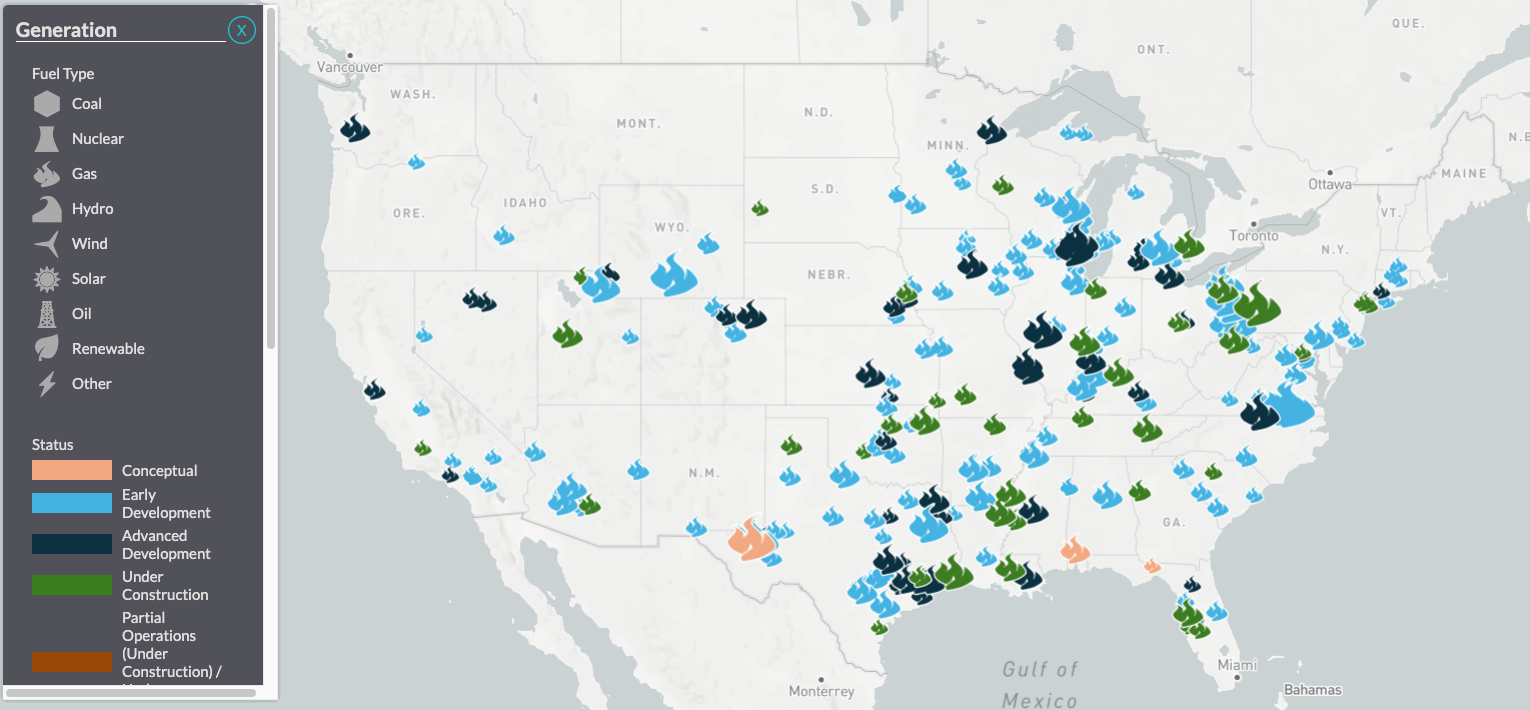
Source: Yes Energy’s Infrastructure Insights showing gas-fired plants 2026-2031
Tracking the Evolving Energy Landscape with Infrastructure Insights
For energy traders and utilities, having clear visibility into the timing and location of new generation, transmission, and load center developments is essential for accurate market forecasting and effective infrastructure planning.
Yes Energy’s Infrastructure Insights tracks construction projects nationwide, delivering the critical data you need to make informed decisions. The solution visualizes key details such as project ownership, size, location, status, and timelines—offering actionable intelligence on upcoming shifts in supply and demand across the US grid.
Contact Yes Energy to schedule a demo and learn how Infrastructure Insights can improve your ability to make better business and trading decisions and drive more revenue.

Meet the Author