

PJM Shifts to a Modern Regulation Market with Bidirectional Signals
Defining PJM's Regulation Market and ACE
Balancing Authorities (BAs) are required to maintain a real-time (RT) balance between supply and demand on the grid; they aim to keep the bulk power system frequency at 60 Hz to ensure a safe, stable, and reliable grid. However, electricity flows continuously across interconnected networks, so any supply-and-demand imbalance can immediately cause the frequency to deviate from the 60 Hz target.
Since the RT Security Constrained Economic Dispatch (SCED) 5-minute dispatch is too slow to maintain the 60 Hz target, NERC requires BAs to manage system imbalances through Area Control Error (ACE). Automatic Generation Control (AGC) uses ACE to adjust generator output and maintain the required 60 Hz frequency, while PJM's 5-minute market-clearing engine co-optimizes energy and ancillary services to set the regulation price. Through PJM’s Regulation Market, this price is what's paid to generators and batteries to keep flexible capacity available; it also reflects the cost of withholding capacity from the energy stack.
How to Interpret ACE and Regulation Prices in PJM:
Negative ACE: PJM is under-generating power
Power is flowing in across interties, or frequency is low
Can lead to higher LMPs if dispatches need to move up the bid stack, or due to increased congestion
Positive ACE: PJM is over-generating power
Power is flowing out unscheduled across interties, or frequency is high
Can lead to lower LMPs (or even negative LMPs) to curtail generation, often caused by wind ramps or dropped load
Low Regulation Price: Grid flexibility is cheap and plentiful
Steady-state conditions
High Regulation Price: Grid flexibility is scarce and expensive
High volatility and ramping: rapid load swings, forecast errors
Phase 1: Single Bidirectional Signal
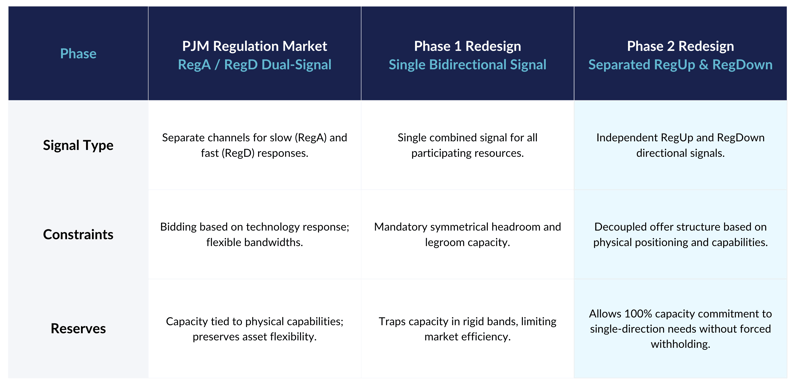
PJM's original Regulation Market was unchanged until it rolled out Phase 1 of the Regulation Market Redesign in October 2025. Phase 1 unified Regulation A (slow tracking) and Regulation D (fast dynamic ramping) into a single bidirectional control signal. However, it required participating resources to maintain symmetrical (equal) upward headroom and downward legroom capacity, forcing generators to hold reserve capacity in both directions simultaneously, regardless of whether real-time grid conditions demanded upward or downward frequency support. This created operational inefficiencies by trapping capacity that could otherwise be economically dispatched or optimized for single-direction reserves, particularly for thermal steam plants, hydroelectric facilities, and variable energy resources.
Phase 2: Separating RegUp and RegDown Signals
Because PJM and stakeholders anticipated this structural inefficiency in Phase 1, Phase 2 was already planned for Q4 2026 (initially planned for Oct 1, 2026, but delayed till Dec 1, 2026). Phase 2 will split the single market into two, decoupling upward and downward regulatory mandates to better match physical system dynamics. Doing so should lead to greater participation by available generating resources and a more efficient economic dispatch across the supply stack.
Phase 2 replaces the single bidirectional signal with Regulation Up (RegUp) and Regulation Down (RegDown) products. Instead of maintaining balanced headroom and legroom, resources can now offer RegUp or RegDown based on their actual positioning, energy schedule, and physical capability.
This unbundling allows operators to procure RegUp and RegDown independently based on live grid conditions and resource capabilities. Under most market conditions, market participants can expect the market to clear more RegUp during high-demand periods and more RegDown when renewable output creates excess generation.
Other Benefits:
-
Flexible Headroom and Legroom: Participants can commit 100% of available capacity to RegUp or RegDown without forced withholding.
-
Independent Procurement: Clearing processes align directly with real-time ACE trajectories and directional frequency needs.
-
Improved Dispatch Flexibility: Unlocking trapped capacity enables units to optimize their position in the economic stack while delivering targeted reserves.
Data Available in Yes Energy
Yes Energy will provide all data related to PJM's new Regulation Market starting December 1, 2026.
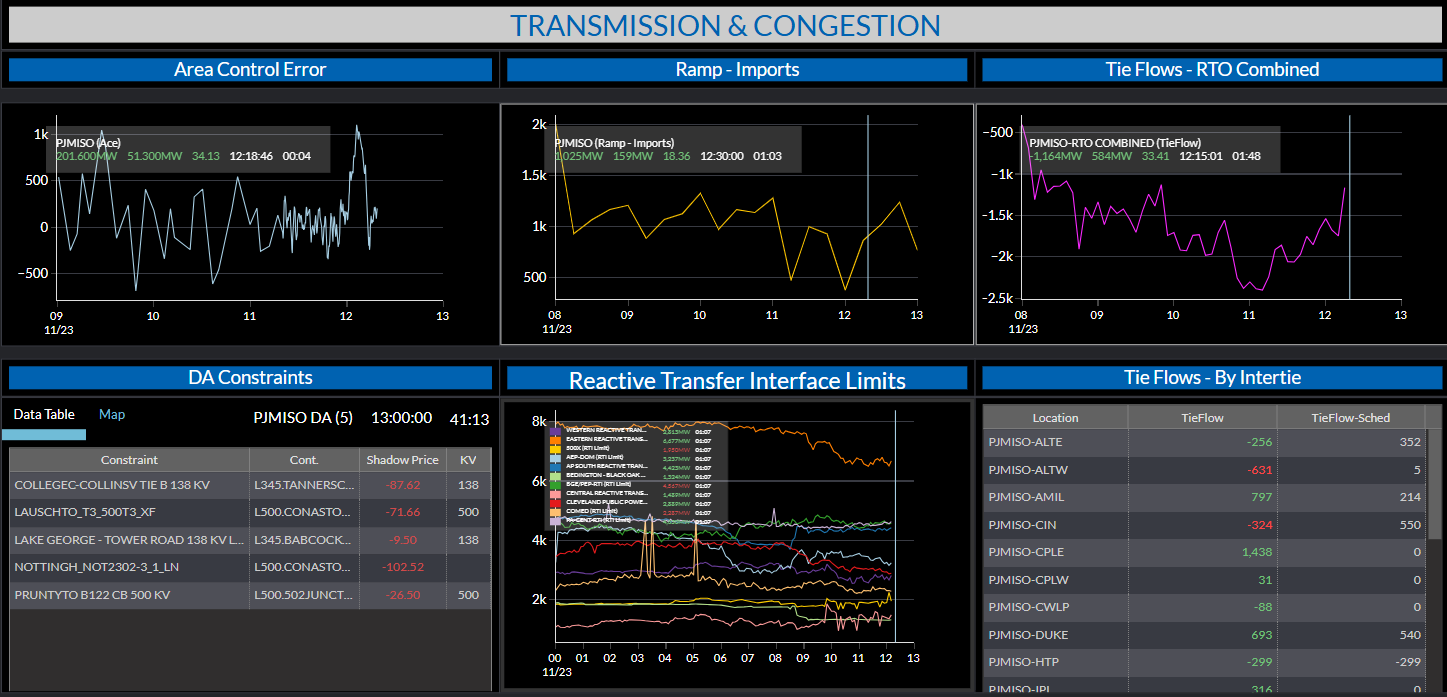 Yes Energy | Stay on top of changes to ACE in Yes Energy's RT monitoring and dashboard tool, QuickSignals.
Yes Energy Market Data Impacts:
-
Ancillary Services > Regulation Prices: 2 new reports
-
Ancillary Services > PJM Regulation Zone Preliminary Billing Data: 2 new reports
- Locational Marginal Prices > Real-Time Ancillary Service Hourly LMPs: Existing report updated
Use Yes Energy's Change Log in the Data Catalog to get more details about the changes to impacted data types, like PJM Reg Capability, after go-live.
Questions?
Reach out to support@yesenergy.com. If you don’t subscribe to PJM data through Yes Energy, talk to our team to learn more and explore access.

Meet the Author