


New expertise expands Yes Energy’s bench in market modeling and forecast validation
Earlier this year, Yes Energy acquired Enelytix, Inc., along with sister affiliates Newton Energy 2, Tabors Caramanis Rudkevich (TCR), and PowerIntel. As a result of the acquisition, Richard Tabors has joined Yes Energy as Vice President of Fundamental Analytics, and Alex Rudkevich now serves as Vice President of Modeling.
This acquisition adds an exceptional enterprise-level, cloud-native modeling architecture with API integration and scalable deployment capabilities. The acquisition also significantly expands Yes Energy’s bench strength in market modeling and forecast validation by adding Tabors and Rudkevich and their experienced teams that possess outstanding expertise in asset valuation and Locational Marginal Pricing (LMP) forecasting.
Richard Tabors: Four Decades Shaping Market Design

Dr. Richard Tabors has led teams addressing the restructuring of power markets in the United Kingdom, throughout the United States, and in Canada. He has held a variety of research and teaching positions at MIT, including Assistant Director of the Laboratory for Electromagnetic and Electronic Systems and Associate Director of the Technology and Policy master’s program. Most recently, Dr. Tabors was co-director of the MIT Energy Initiative’s “Utility of the Future project.”
Tabors formed Tabors Caramanis & Associates (TCA) in 1988. It was later acquired by Charles River Associates in 2004. In 2014, Tabors formed a new TCR consultancy, adding Dr. Alex Rudkevich to the leadership team. TCR has provided litigation support and consulting to a wide range of power-industry stakeholders, including generation and transmission companies, Independent System Operators (ISOs) and Regional Transmission Organizations (RTOs), distribution utilities, energy policy makers and regulators, efficiency program administrators, environmental groups, and consumer advocates.
Alex Rudkevich: From LMP to LMER

Dr. Alex Rudkevich is a mathematician and economist who joined Tabors at TCA in 1998. Rudkevich has brought extensive expertise in modeling and design of power markets and the optimization of power systems and natural gas supply. He has more than 40 years of experience providing consulting, research, and expert testimony on the design and operation of power systems. His area of expertise includes valuation of generation and transmission assets, price forecasting and development of forward curves, evaluation of alternative power market designs, capacity and ancillary services, the assessments of financial transmission rights and marginal losses, and analyses of market power and mitigation measures.
In a joint effort with electrical engineer and economist, Dr. Pablo Ruiz, Rudkevich developed the original mathematics of what is now known as Locational Marginal Emission Rates (LMERs). The LMER concept was introduced in 2009 – originally as an approach to better understand and visualize the efficacy of carbon reduction efforts in constrained power networks. The team later utilized the concept of locational carbon footprints to formulate the Carbon Footprint Theorem, which provided the mathematical foundation for Scope II carbon accounting using LMERs. They also provided mathematical proof that investment decisions based on LMERs are the most economically efficient way to decarbonize the grid.
Rudkevich, along with co-founder Dr. John Goldis, deployed the first commercial version of ENELYTIX® in 2013 using the Polaris System Optimization engine developed by Russ Philbrick. ENELYTIX is a cloud-hosted decision-support platform for the energy industry.
AI-Driven Demand Is Changing How Power Markets Price Risk
AI-driven data centers are likely to be one of the most significant structural changes to wholesale electricity markets since the introduction of competitive markets by fundamentally changing where, when, and how much power is needed. As a result, wholesale power pricing and asset valuations are becoming considerably more complex. AI introduces a new class of very large, relatively inflexible loads that interact with transmission constraints and generation economics. Load growth becomes much less predictable. Price volatility and risk increase predominantly due to congestion. Capacity markets become more valuable. Energy storage valuation becomes more complex, and generator valuation changes based on location, transmission constraints, deliverability, and flexibility. As a result, more nuanced, bankable forecast scenarios require an exceptionally high level of market expertise and experience -- the kind of expertise and experience provided by original LMP and LMER market designers, Tabors and Rudkevich.
How Locational Marginal Pricing Was Born
In the late 1980s and 1990s, three converging developments prompted the need for Locational Marginal Pricing (LMP) in wholesale power markets: the restructuring of electricity markets, the growing importance of transmission constraints, and the market’s recognition that electricity flows according to physics rather than commercial contracts. The foundation for LMP began with the development of the concepts of spot pricing in the 1970s and through the 1980s by a team at MIT led by Energy-Market Economist, including Dr. Tabors, his senior team member, Dr. Fred Schweppe, as well as Drs. Michael Caramanis and Roger Bohn. The team authored numerous technical papers culminating in its seminal work, “Spot Pricing of Electricity,” published in 1988. The “Yellow Book” provided the theoretical and practical underpinning for Locational Marginal Pricing in competitive power markets – arguing that electricity should be valued and priced at its “instantaneous marginal cost,” which changes every few minutes because:
-
Load changes
-
Generator availability changes
-
Transmission congestion changes
-
Transmission losses change
What This Expertise Means for GridSite
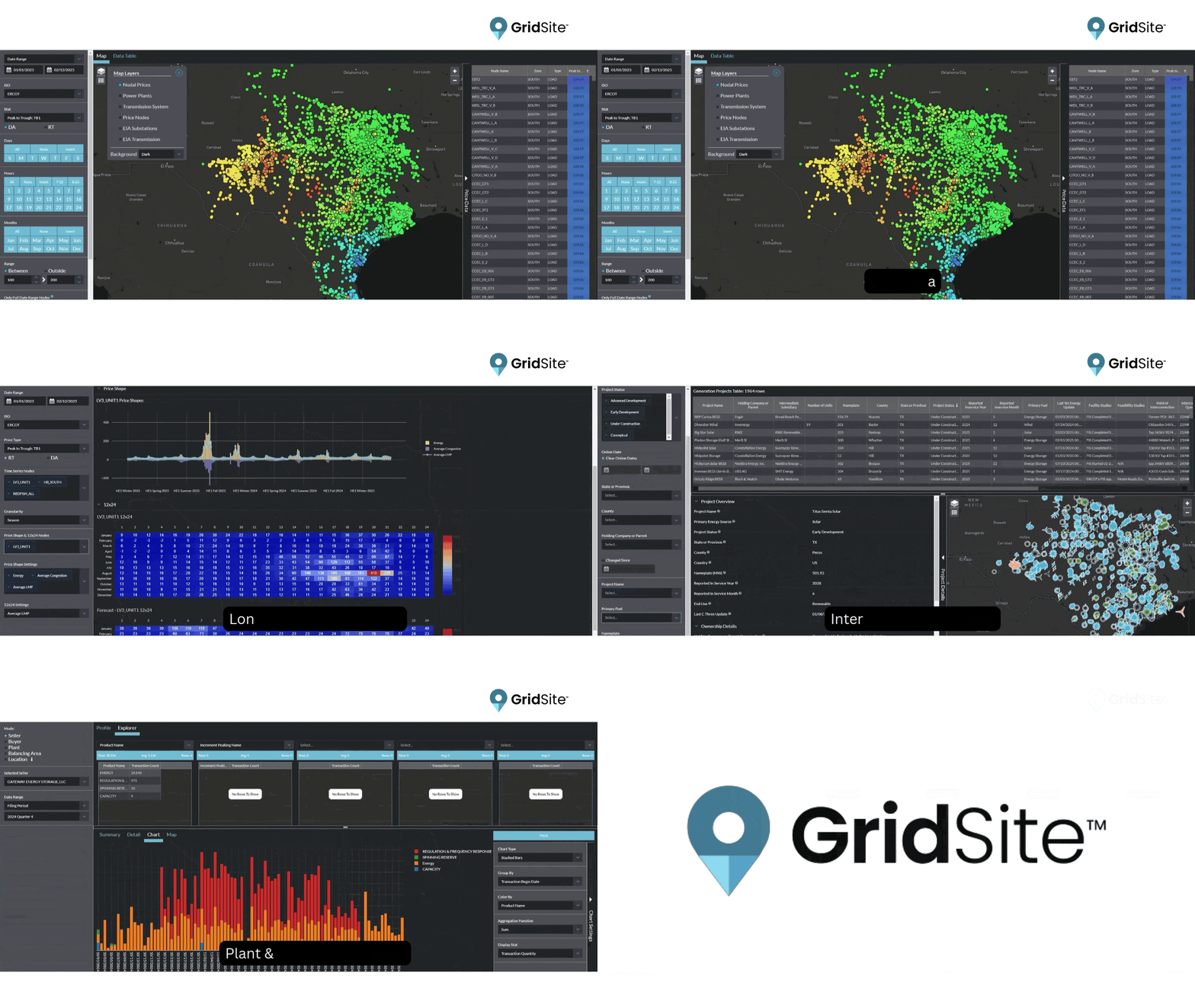
For customers, the expertise that Tabors and Rudkevich bring isn’t simply academic. It directly shapes how Yes Energy builds long-term nodal forecasts, evaluates transmission constraints, models future generation buildout, and produces internally consistent price and emissions forecasts that can withstand technical and regulatory scrutiny.
“Our focus has always been on delivering rigorous forecasts that account for transmission constraints and real-world market fundamentals,” said Tabors. “Joining Yes Energy allows us to scale that approach within a broader data ecosystem and continue advancing the technical depth and transparency the market demands.” The dramatic growth in electricity demand, combined with renewables representing a larger share of generation, will require that the grid be more efficient than ever before. Planning and executing in this environment will require computationally scalable models that can run quickly and offer extremely granular, nodal-level insights into price formation. That scalability is enabled by the ENELYTIX platform, which synthesizes cutting-edge advancements in high-performance computing, big data analytics, weather science, and multi-product optimization. ENELYTIX’s nodal forecasts combined with Yes Energy’s industry-leading data and analytics infrastructure, will expand the company’s ability to support investment-grade decision-making across increasingly complex power markets.
“From a modeling standpoint, the combination of AI growth, uncertainty, system complexity, and the need for locational and temporal precision places tremendous challenges on modeling methods and tools,” said Rudkevich. “ENELYTIX technology can enhance Yes Energy decision support platforms, such as GridSite, with the additional computational power of parallelization. This makes it possible to deliver asset owners, developers, and other power market stakeholders highly granular results based on the entirety of grid physics and economic data at the nodal level.”
Why This Matters
The ENELYTIX acquisition positions Yes Energy as one of the most vertically integrated and technically advanced data, modeling, and forecasting platforms serving power market stakeholders. With the additional expertise of Tabors and Rudkevich – the pioneers who essentially wrote the rules for competitive power market pricing and emissions – customers gain access not only to more advanced forecasts, but to the expertise, transparency, and scientific rigor behind them.
Ready to see GridSite’s forecasting methodology in action? Request a GridSite demo.
Meet the Author