

The energy industry is changing quickly. New market constructs are coming online. Renewables are reshaping generation portfolios. And the teams responsible for scheduling, trading, settlements, and risk are being asked to do more—with less room for error and less tolerance for manual workarounds.
Yes Energy’s PowerCoreTM was built for this reality—not as a collection of point solutions, but as an integrated, end-to-end platform that supports the full arc of energy market participation from the first bid submission through final settlement and invoice.
This roadmap highlights our current state, next steps, and the guiding philosophy behind it all.
This is not aspirational. The features described in this post are in production today or in active development. The goal is to give customers—and the market—a clear picture of what's possible now, and what's coming next.
Where PowerCore Stands Today
Before looking ahead, it's worth noting what's already deployed. Across multiple ISOs and market constructs, PowerCore customers are actively scheduling, bidding, analyzing, and settling in a single, integrated environment—not patching together outputs from disconnected systems. Here's an overview of the platform today:
-
Scheduling (ScheduleCore): Active across the Southwest Power Pool Integrated Marketplace (SPP IM & RTOE), and California Independent System Operator (CAISO). Supports day-ahead, real-time, and virtual market participation for CAISO. Brings both the base scheduling (BSAP) and bid submission (SIBR) workflows together for CAISO’s Energy Imbalance Market (EIM) merchant participation.
- Analytics (AnalyticsCore): Pulls 100% of available market API data into the platform for SPP IM and CAISO Day-Ahead Market Enhancements (DAME) and Extended Day-Ahead Market (EDAM).
- Settlements (SettleCore): Systematically validates settlement cycles and invoices across SPP IM, CAISO, WEIM, and EDAM, supporting accurate accounting and faster close.
-
Contracts and Positions (ETRMCore and ContractCore): Configurable position analysis for short-term decision-making, with invoicing that handles both simple and complex bilateral contracts in one place.
- Transmission Billing & Allocations (TransmissionCore): Automates transmission billing, settlement validation, and cost allocations for Transmission Service Providers (TSPs) and market participants. Supports complex transmission contracts and tariff calculations while integrating schedules, e-Tags, meter data, and billing determinants to calculate charges, generate invoices, improve transparency, and support dispute resolution.
Recent releases have continued to deepen that foundation—including shadow settlement support for new DAME/EDAM products, aggregated profit-and-loss tracking in visual analytics, dynamic limit management improvements, enhanced invoicing and position analysis in ETRMCore and ContractCore.
/Branded%20Stock%20Photos/Branded%20Stock%20Photo%20-%20City%20Scape%20Connectivity.png?width=600&height=430&name=Branded%20Stock%20Photo%20-%20City%20Scape%20Connectivity.png)
The Bid-to-bill Roadmap: What's Coming Next
Transmission Billing & Allocations (TransmissionCore): Automates transmission billing, settlement validation, and cost allocations for Transmission Service Providers (TSPs) and market participants. Supports complex transmission contracts and tariff calculations while integrating schedules, e-Tags, meter data, and billing determinants to calculate charges, generate invoices, improve transparency, and support dispute resolution.
Here’s what’s newly implemented and upcoming for 2026:
SettleCore SPP RTOE Coverage
As western utilities join SPP’s Regional Transmission Organization Expansion (RTOE), SettleCore provides comprehensive settlement coverage for the market. Customers can analyze a complete view of SPP IM settlement data without standing up parallel processes or waiting on downstream reconciliation.
ScheduleCore and SettleCore: DAME and EDAM
ScheduleCore consolidates real-time (RT) and day-ahead (DA) scheduling workflows for DAME and EDAM within a single coordinated platform, helping teams streamline participation as the markets evolve. SettleCore enables the analysis and validation of DAME and EDAM settlement data, helping organizations reconcile financial outcomes, investigate variances, and ensure accurate billing.
ETRMCore Invoicing
The near-term evolution of ETRMCore moves teams beyond short-term checkouts and into forward-looking exposure views through longer-term position analysis. At the same time, ETRM invoicing for bilateral and complex contracts will come directly into ContractCore—eliminating the need to manage financial outcomes across disconnected systems.
SettleCore SPP Transmission Settlements
PowerCore is expanding SettleCore to support the review and validation of SPP transmission settlements and invoices alongside traditional ISO/RTO market settlements. This will centralize ISO/RTO settlements and transmission bills into a single review process, so teams no longer need to manage separate workflows for validating what they owe and are owed.
Looking a bit further into the future, PowerCore will soon:
-
Support full end-to-end coverage for SPP Markets+ across AnalyticsCore, SettleCore, and ScheduleCore—including 100% of private customer data. The goal is to provide a single environment for scheduling submissions, settlement actualization, and reporting as Markets+ evolves.
The common thread across these investments is simple: helping organizations manage the full bid-to-bill lifecycle in a single environment. As markets become more interconnected and operational complexity increases, addressing the fragmentation between market and operational data that exists across much of the industry today requires a unified approach to data that connects market intelligence, operational execution, and financial outcomes.
The Data Vision: A Unified, Governed Data Layer
Running beneath every existing module and roadmap initiative is a data strategy that Yes Energy believes is fundamental to the future of energy market operations. The current reality for most teams— even sophisticated ones — involves significant fragmentation: market and operational data living in separate systems, accessed through different paths, with manual steps required to reconcile them into something useful. The result is a disconnect between understanding what happened in the market and understanding what it meant for your organization.
The vision is to eliminate that fragmentation entirely.
Two Types of Data—One Unified Layer
Yes Energy works with two distinct categories of data:
-
Market data: Curated, enriched data from ISO/RTOs, reference data from external sources, and proprietary data from Yes Energy. Integration here is well-established.
-
Operational data: Asset portfolio data, private market data (e.g., settlement statements and billing), and unique customer data, such as meter readings and weather inputs.
The goal is to bring both into a single, governed, unified data layer, creating a true single source of truth for decision-making across the organization.
Design Principles for Data Delivery
Yes Energy has defined six principles that govern how data is delivered—and that apply equally to both market and operational data:
-
Interoperable: Meet customers where they are. The data layer can serve as an analytics endpoint or a governed delivery layer, depending on how a team works.
-
Analytics-Ready: No additional extract/transform/load (ETL), transfer, or storage required. Data is immediately usable for SQL queries, business intelligence tools, and AI applications.
-
Revision-Aware: Strong versioning and change data capture that prevent upstream schema changes from breaking downstream systems. Change management is controlled, not chaotic.
-
Scalable: Built to handle large operational and market datasets, support vintage data, and grow with customer compute and latency requirements, without accumulating custom builds and one-offs.
-
Latency Aligned: Data delivery frequency is matched to the decision cycles it supports, from real-time operational needs to end-of-day reconciliation.
-
Governed and Observable: Market systems are critical infrastructure. Yes Energy builds for audit readiness and financial controls from the ground up.
Expected Outcomes
Our vision is about creating a trusted foundation that allows market intelligence and operational data to work together—supporting analytics, reporting, AI applications, and operational workflows from a common source.
In practical terms, this means organizations can move beyond simply managing individual stages of the bid-to-bill lifecycle and begin understanding the relationships between them.
When both market and operational data flow through a single, governed layer into PowerCore—and ultimately into customer decision systems—the operational impact compounds:
-
Reduced manual reconciliation across settlements, positions, and billing.
-
Faster identification and correction of market misalignment by connecting operational activity directly to market conditions and settlement results.
-
Better dispatch optimization through a cleaner feedback loop between decisions and financial outcomes.
-
Stronger cross-functional participation — settlements move from after-the-fact reconciliation to an integrated contributor in real-time operational workflows.
-
Measurable affordability improvements: fewer errors, less rework, lower administrative overhead.
This evolution is about standardizing data delivery and eliminating the fragmented access paths, one-off integrations, and custom pipelines that slow teams down. It is not about replacing systems in ways that disrupt existing workflows.
The User Experience Commitment
Alongside the market and data initiatives, Yes Energy is investing in sustained efforts to make PowerCore more accessible—particularly for users who are new to the platform or working through high-volume, time-sensitive workflows.
The focus areas are practical and specific:
-
Improved flows that help users complete tasks faster.
-
A clearer, more intuitive interface that reduces the cognitive load of navigating complex market workflows.
-
Better error and empty-state messaging, so users can recover quickly rather than getting stuck.
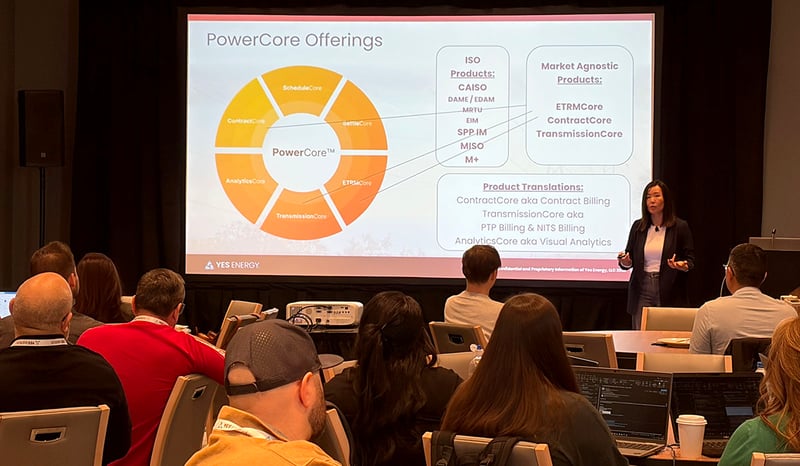 Yes Energy's EMPOWER 26, PowerCore Track with Joyce Jenq, Senior Product Director.
Built With Customers, Not Just for Them
Yes Energy's roadmap is shaped directly by the teams using PowerCore. Customer feedback drives prioritization decisions, including which gaps are closed first, which new market constructs get supported, and where UX investment is most needed.
That feedback loop is formalized through ongoing roundtable discussions with active customers covering areas such as AI integration, settlements user experience, and outage management. These aren't advisory exercises—they're working sessions where customer input directly influences what gets built next.
If your team is navigating the operational complexity of modern energy markets and wants to shape what comes next, we'd like to hear from you. Contact Yes Energy to learn more about how PowerCore plans to close the gaps between where energy market operations are today and where they need to be.

Meet the Author