

This is the fourth and final article in Yes Energy’s summer demand series on new market complexities. In previous articles, Alex Bennitt, Product Manager for Yes Energy, explored macro-level demand trends, load projections, and market uncertainty, as well as demand projections for major ISOs. We also looked at how hyperscale data centers like OpenAI’s Stargate Abilene are actually operating on the grid, and whether the demand and price response we'd expect is showing up in the data. Now, we’ll unravel the mystery of how crypto mining is impacting the market.
Why Crypto Mining Is One of the Grid's Most Price-Responsive Loads
Crypto mining is the process of verifying a cryptocurrency transaction and adding it to the blockchain (the public record of who owns what). Because there is no bank or central authority in charge of these transactions, miners do this by racing to solve a difficult math problem — essentially guessing random numbers, billions of times per second. Whoever guesses the correct number first gets to add the transaction (the block) to the blockchain and is rewarded with newly created cryptocurrency and transaction fees.
To win this race, miners build massive warehouses full of specialized computers that run around the clock, all guessing numbers as fast as possible. The more miners competing for the blocks, the harder the math problem becomes to solve. The harder the math problem, the more compute resources (and electricity) required.
These facilities are power-hungry but also price-responsive, making them the flexible load wildcard on today’s grid. Just as solar additions and cheap battery offers have created bearish pricing dynamics across markets, so too do crypto mines when they curtail.
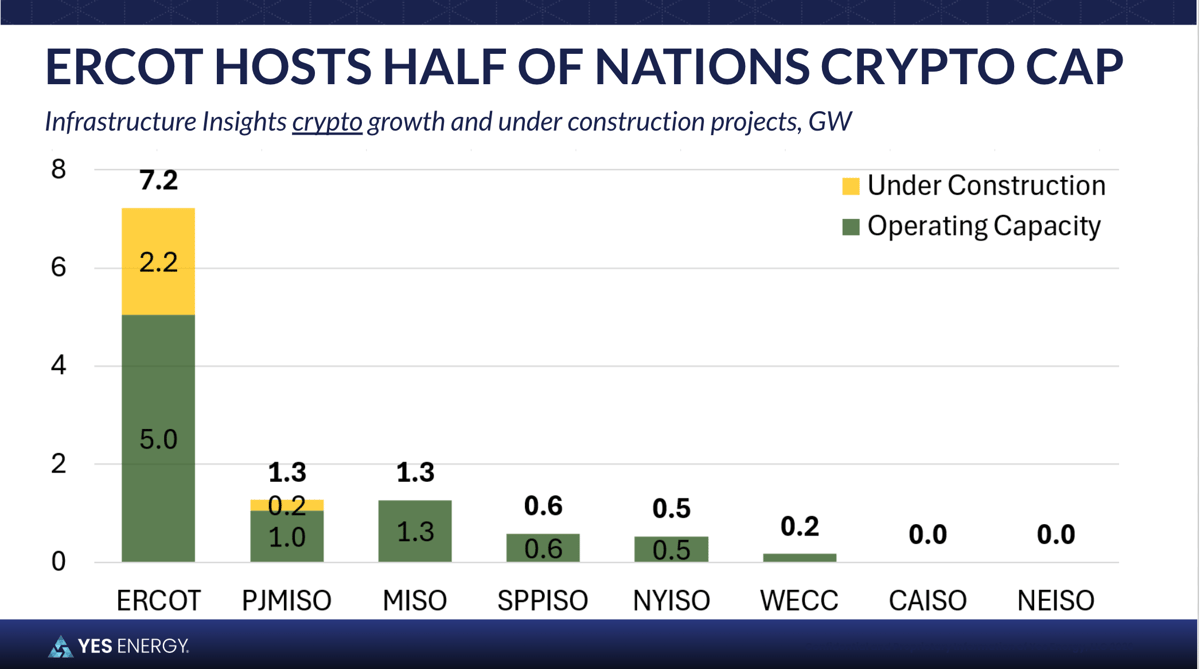
Most of the nation’s crypto mines are in ERCOT, which has 5 GW of operating capacity and another 2.2 GW under construction. PJM is the only other ISO where a crypto mine is currently being built. California and New England have no crypto capacity, likely due to a combination of factors, including high electricity prices, lengthy grid interconnection queues, and challenging regulatory environments.
Current Crypto Capacity Levels and Trajectory
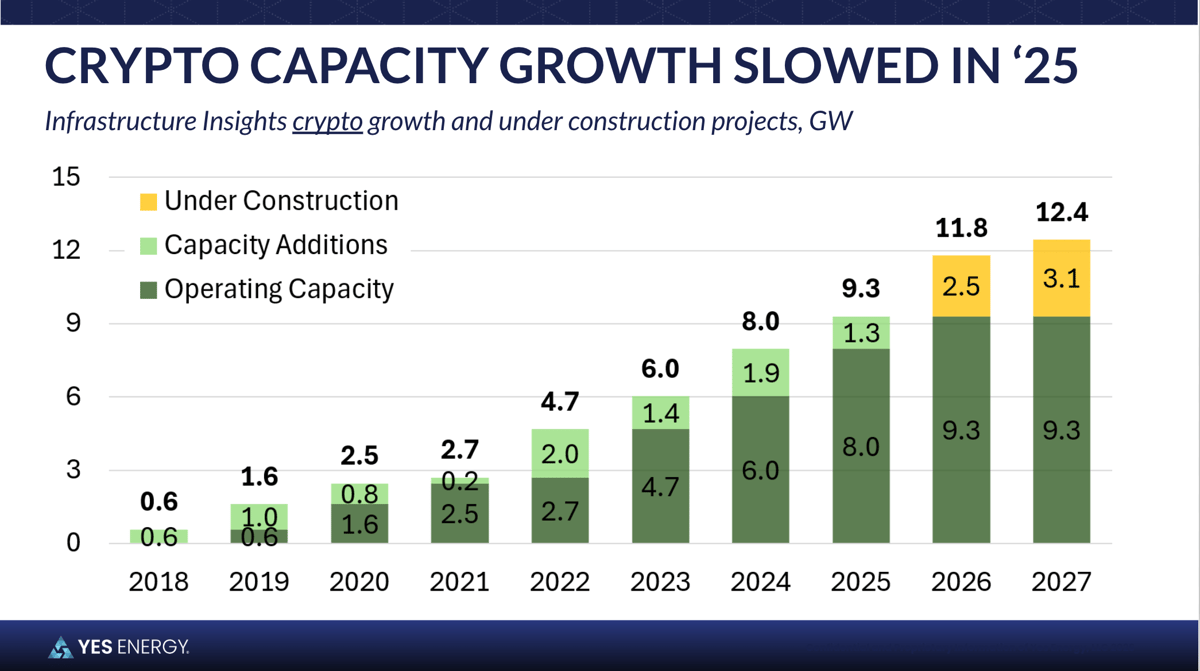
Crypto capacity really took off in 2022: 2 GW were added that year, bringing the total to 4.7 GW. From 2023 to 2025, capacity doubled again, reaching 9.3 GW.
Capacity additions slowed in 2026 and 2027, possibly because priorities changed for these facilities.
 Source: Yes Energy Infrastructure Insights.
There is some uncertainty about the future of crypto mines. As of June 2026, the value of crypto has been cut in half since its peak in late 2025, making mining economics more challenging.
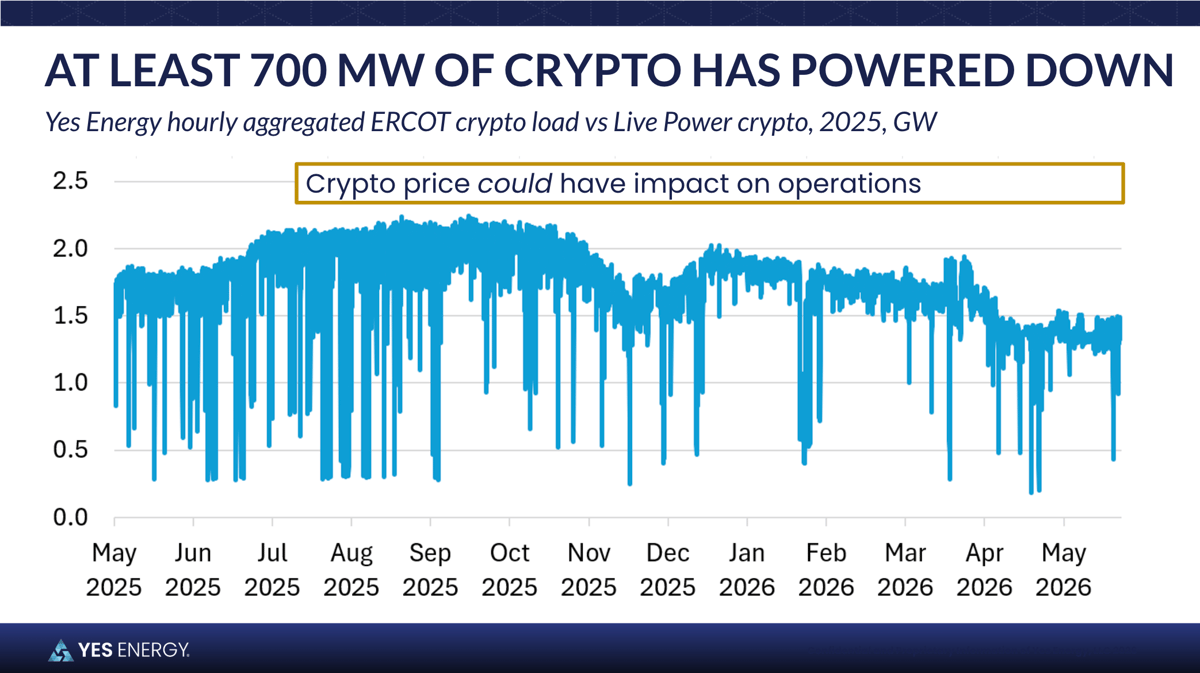
That challenge shows up clearly in the load data. In ERCOT, the largest grid-connected crypto mines account for roughly 3 GW of nameplate capacity. Like hyperscale data centers, crypto mining operations typically run well below that ceiling. Actual load peaked at 2.2 GW last summer, or roughly 70% of nameplate. It fell to 1.5 GW over the winter, ticked back up to around 2 GW at the start of the year, then declined again through May 2026. At this writing, that same 3 GW of nameplate capacity supports only about 1.5 GW of actual load.
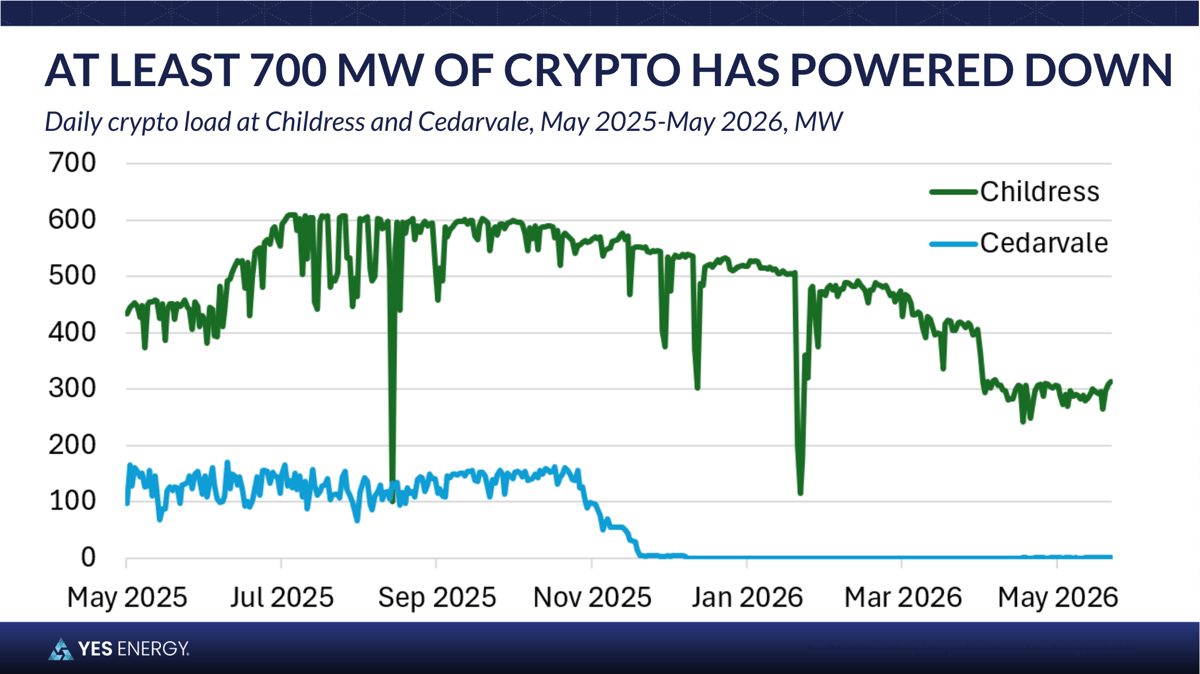
In addition to the declining market value for currencies such as Bitcoin, crypto facilities — with their established ISO interconnections — are prime targets for AI companies seeking vast amounts of firm power. The more favorable economics of transitioning to an AI data center may be driving a nearly 700 MW reduction in crypto load over the last year.
 The picture is clearer when we look at the facility level. With a nameplate capacity of 750 MW, Childress is one of the largest grid-connected crypto mines in ERCOT. Last summer, its load was around 600 MW, and by May 2026, it had dropped to 300 MW. Cedarvale, with a 235-MW nameplate capacity, has dropped off the grid completely, along with a handful of other crypto facilities.
Inside a ~3 GW Near-Simultaneous Curtailment Event: What Happened to Market Fundamentals
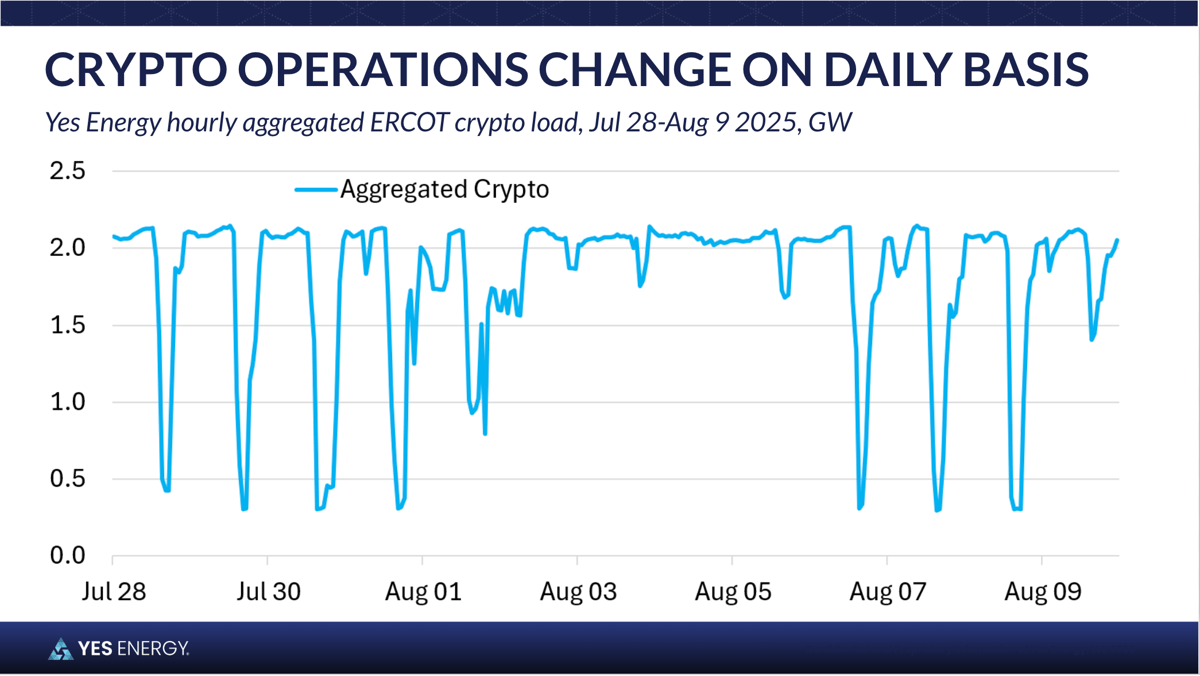
Unlike hyperscale data centers, crypto operations can and do curtail gigawatts of demand in an instant. Aggregated SCED data from the largest grid-connected facilities in ERCOT show that on some days, nearly 2 GW can drop off the system.
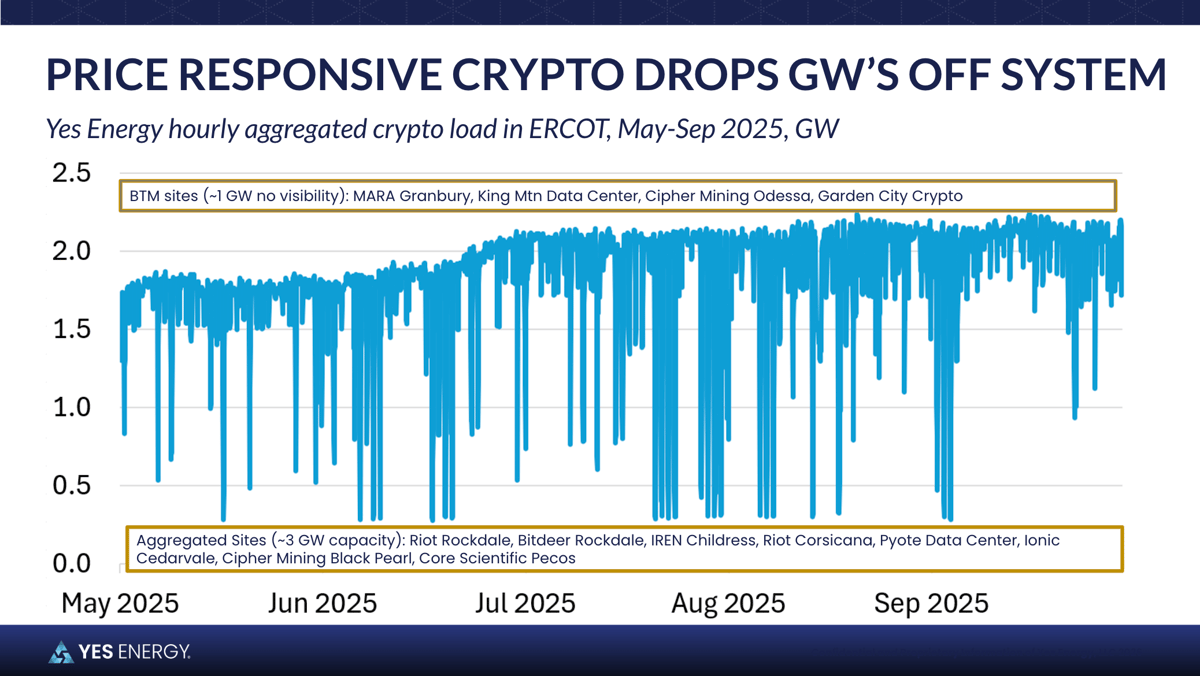 Curtailing crypto operations puts downward pressure on scarcity dynamics, but what’s driving that pressure?
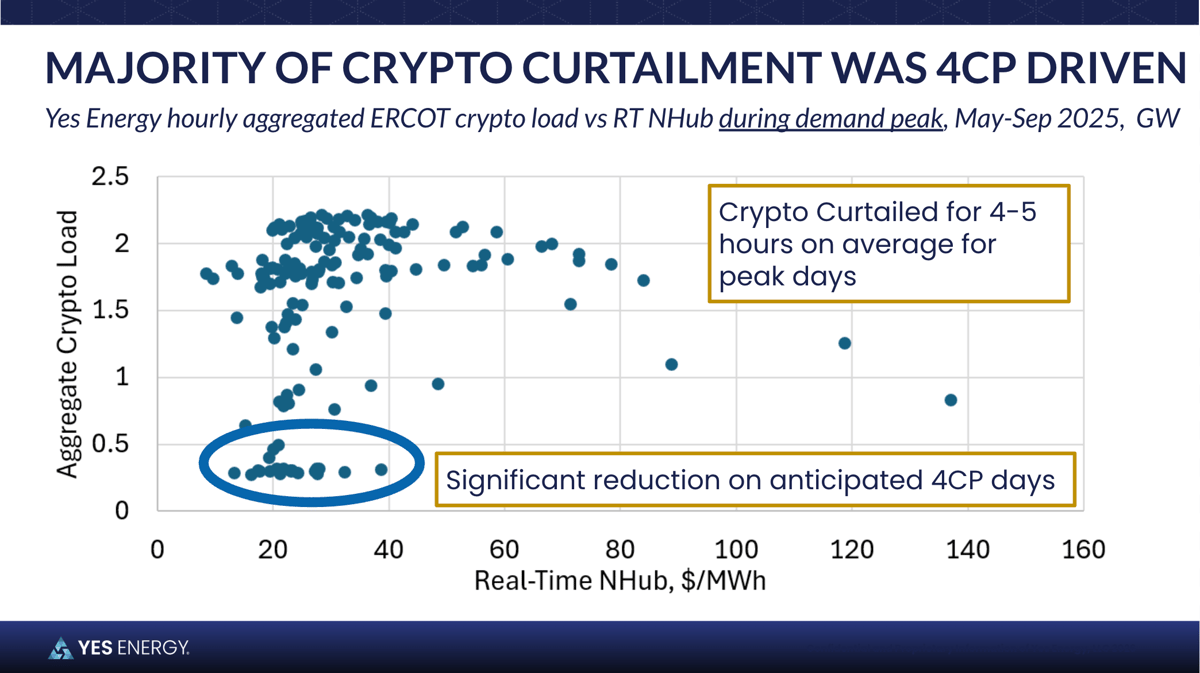
The majority of curtailment in ERCOT is Four Coincident Peak (4CP) related. 4CP measures the system’s highest 15-minute load interval in each of June, July, August, and September, then averages the large customer’s load during those four intervals to set its transmission charges for the following year. It’s a pricing mechanism that incentivizes large loads to curtail during those windows, thereby lowering their energy costs.
Comparing the aggregate crypto load to real-time North Hub prices during peak demand, the data show they curtailed not because real-time North Hub prices were high (they were under $40 per MWh). Rather, they curtailed to lower their demand during 4CP intervals, so they didn’t get hit with high peak demand charges. Crypto curtailed an average of four to five hours during these peak days and then ramped back up an hour after the peak hit.
 However, they behave quite differently during net load peak intervals. During the majority of net load peaks, there's over 70% utilization of their 2.2 GW observed peak load. There's no meaningful curtailment tied to these net load peaks… up to a point. Once prices approach or exceed $150 per MWh, curtailments kick in, revealing the price-responsive nature of crypto mines. Crypto operations generally drop as electricity prices rise.
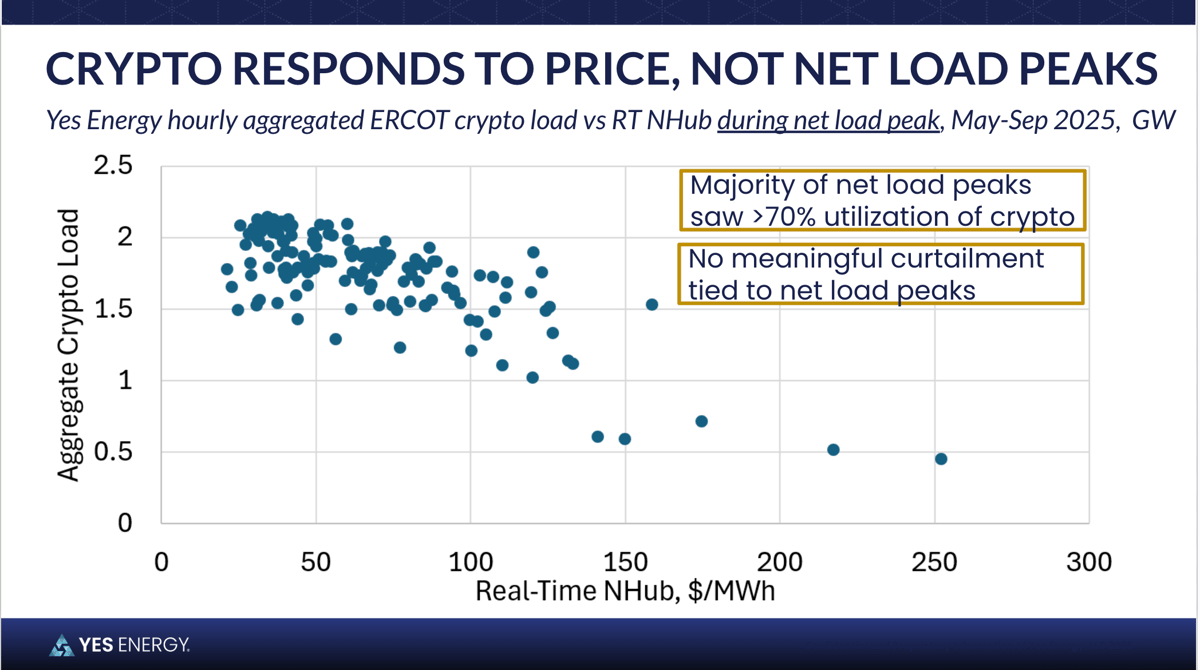 That plays out across all hours, not just the peaks. At $100 per MWh, the aggregated crypto load is above 1 GW, but when pricing approaches $140 per MWh, it starts to trend downward. Meaningful curtailment begins at the $150 per MWh mark, where there’s more than a 50% load reduction. Loads drop off as prices exceed $300 per MWh.
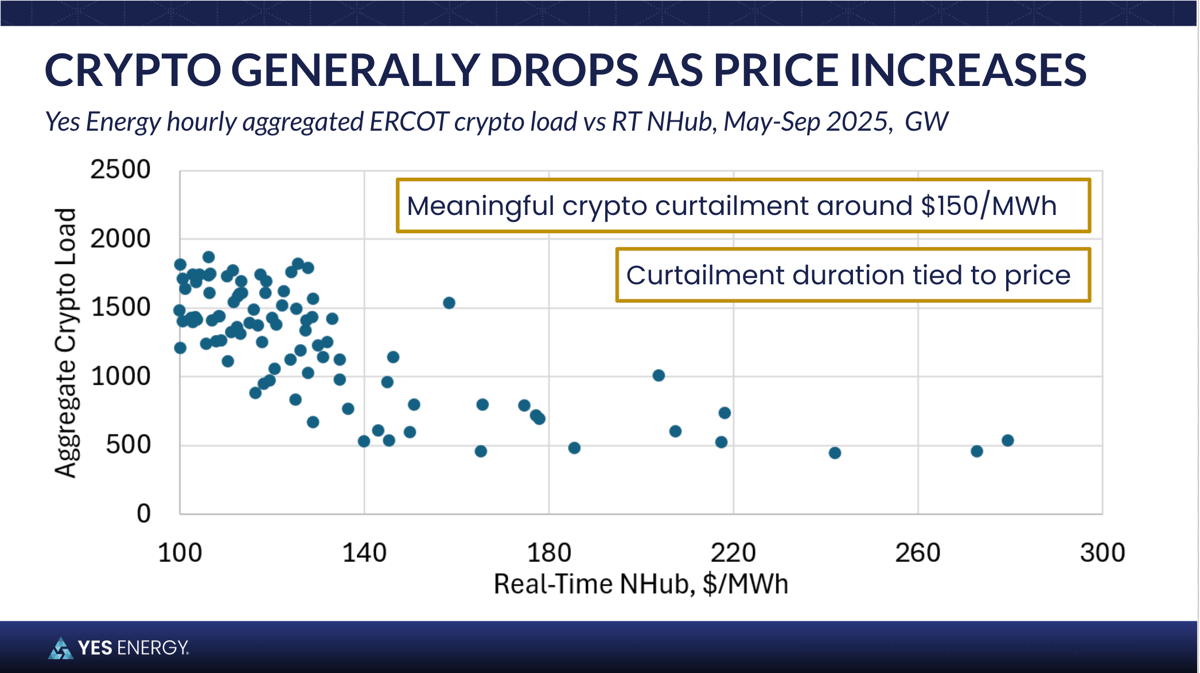 There are some facility-by-facility variances, but the aggregated data show a direct correlation between curtailment duration and price. These facilities tend to curtail for about two hours on either side of the anticipated peak demand, and as soon as prices drop, crypto comes back online incrementally. For example, if prices spiked to $300 per MWh for an hour and then returned to $40, we would see crypto load drop for that single hour before it returns to its full output.
What Does This Mean for Grid Operators, Traders, and Planners?
Crypto mining operations change on a daily basis. Many external factors determine curtailment levels and what they respond to, which makes it difficult to predict how they will operate. The logic of their actions makes sense in hindsight, but not in the moment.
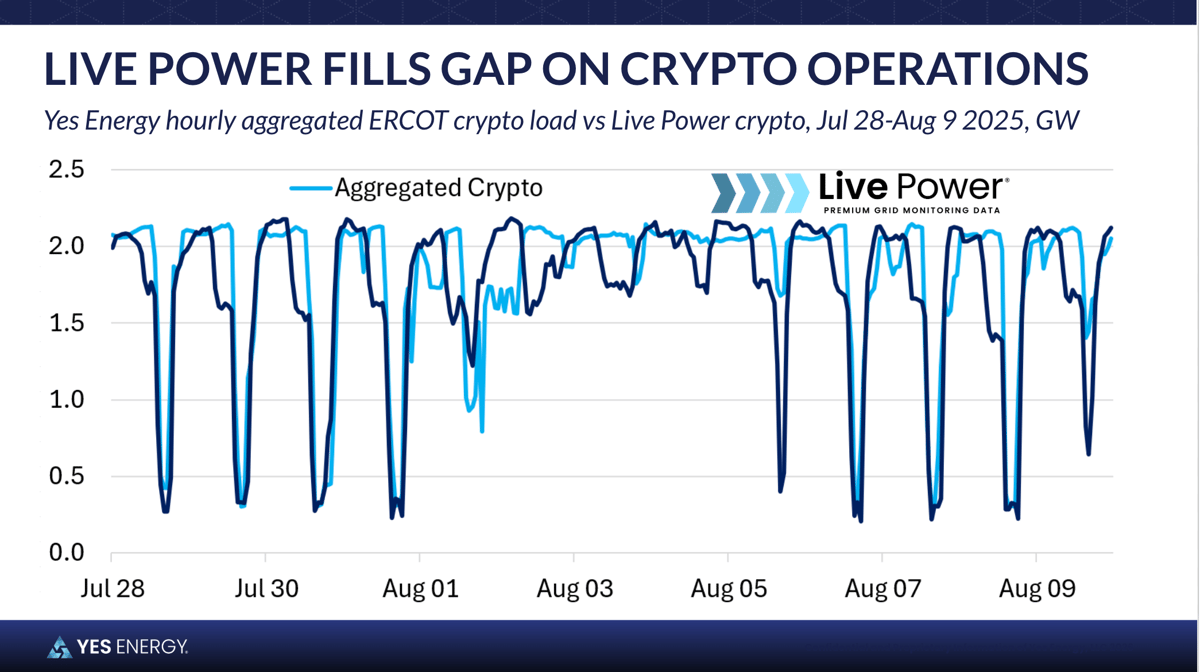
 Fortunately, Yes Energy monitors crypto operations in real time through Live Power. Live Power uses field-based physical sensors to measure magnetic fields and monitor transmission, generation, and load centers.
This is a game-changer in ERCOT, where data is published on a 60-day lag. Live Power has a little more than 1 GW of monitored crypto capacity in ERCOT, providing you with a real-time view into operations.
It’s also particularly helpful for tracking facilities in ISOs that don’t provide the granular operational data that ERCOT does. For example, Live Power is covering a crypto mine in New York and one in SPP, providing users with their hourly outputs.
Final Thoughts
The data show that, overall, crypto’s current impact on power markets is minimal. As a price-responsive resource, operators can and do curtail significant amounts of load once grid prices reach about $150 per MWh, or if they’re trying to cut load during 4CP intervals.
Both crypto mines and hyperscale data centers operate well below their nameplate capacity; however, that’s where the similarities end. Unlike crypto facilities, hyperscalers show no meaningful price response, even under the most challenging grid conditions.
As data center capacity continues to climb to unprecedented levels — up 5x in under a decade — crypto has shown signs of decline over the past year, in terms of both overall load and utilization.
So, how can you estimate the current and future size of responsive crypto load?
In the webinar, Alex recommends derating reported nameplate capacity to 50-60% when you're sizing how much responsive crypto load is actually out there.
If you want to learn more about Live Power and how it can help you understand how crypto mines are impacting the markets, watch the full webinar or request a demo.
Catch up on our summer demand series with these articles:
-
Complex Load Growth: Setting the Stage. A look at macro-level demand trends, load projections, and market uncertainty that’s impacting traders, asset developers, and resource planners.
-
Demand Projections: When, Where, and How Much. A deep dive into demand forecast shifts over the past few years, and how those numbers hold up against actual grid load.
- What Does a Hyperscale Data Center Really Look Like? A first look at operational data from OpenAI’s Stargate Abilene that reveals how hyperscale data centers are actually operating on the grid — and whether the demand and price response we'd expect is actually showing up.
Meet the Author