

The US power sector is entering one of its most uncertain eras in decades. New regulations under the Trump administration reverse support for clean energy, prioritizing fossil fuels while freezing permits for wind, solar, and storage projects. At the same time, demand is growing faster than expected, driven by electrification, manufacturing, and data center expansion.
This convergence has left developers facing permitting backlogs, supply chain barriers, and financing risks, while utilities, traders, and asset managers must navigate volatile capacity prices and shifting market constructs. Offshore wind projects are delayed or abandoned, turbine supply chains are strained, and capacity accreditation reforms are changing how resources are valued.
Markets are responding but unevenly. Interconnection reforms, new accreditation methods, and higher prices are all pushing for reliability, yet bottlenecks remain. For market participants, the challenge is not predicting a single outcome but modeling multiple possible futures and making resilient decisions.
See the most important energy market trends and possible future scenarios.

US Energy Regulations Adding Pressure to Existing Electric Power Market Barriers
A Shifting Policy Environment
The US energy sector has always been shaped by political cycles but rarely with today’s intensity. The Trump administration has rolled back EPA Rule 111(d), declared an energy emergency, and prioritized fossil generation. The Department of Energy has reinforced this shift by encouraging investment in aging coal plants and new gas builds.
At the same time, Inflation Reduction Act (IRA) credits are now far harder to access. Projects must begin construction by 2027 and be online by 2028, deadlines that are already unrealistic under current permitting freezes. Many developments once modeled with expected credits are now uneconomic, undermining billions in planned investment.
Energy Market Trends and Historical Context
Even before these reversals, US electric power markets struggled with:
- Aging infrastructure: Congested transmission and outdated pipelines present challenges.
- Flat reserve margins: NERC has repeatedly flagged tightening supply-demand balances.
- Slow interconnection: Developers already faced years-long approval processes.
Federal actions add layers of uncertainty, slowing renewable expansion while shifting capital toward fossil projects that also face procurement hurdles.
Historically, lapses in tax credits or shifting emissions standards created boom-and-bust cycles. What makes today different is demand: data centers, electrification, and industrial reshoring are driving sharp load growth. Policy reversals in this context threaten not just the type of capacity built but whether enough capacity can be built at all.
Stakeholder Perspectives
- Developers: IRA-backed projects are no longer financeable; many will be abandoned midstream.
- Utilities: IRPs must be reworked, balancing gas extensions, legacy plants, or increased purchases.
- Traders: Scarcity pricing creates both opportunity and risk as renewables stall.
- Investors: Policy swings raise risk premiums, slowing long-term capital allocation.
Scenarios and Why This Matters
- Fossil Priority Holds: Federal support for gas and coal extends plant operations and boosts near-term reliability, but rising costs and emissions undermine long-term progress.
- Federal-State Conflict: Divergent mandates create uneven project viability across states.
- Policy Reversal: Future administrations may restore credits, but investor caution could slow response.
Bottom line: Federal regulation is no longer a background assumption – it is a volatile variable that market participants must model. Scenario planning should treat policy risk as central to every investment, trading, and planning decision.
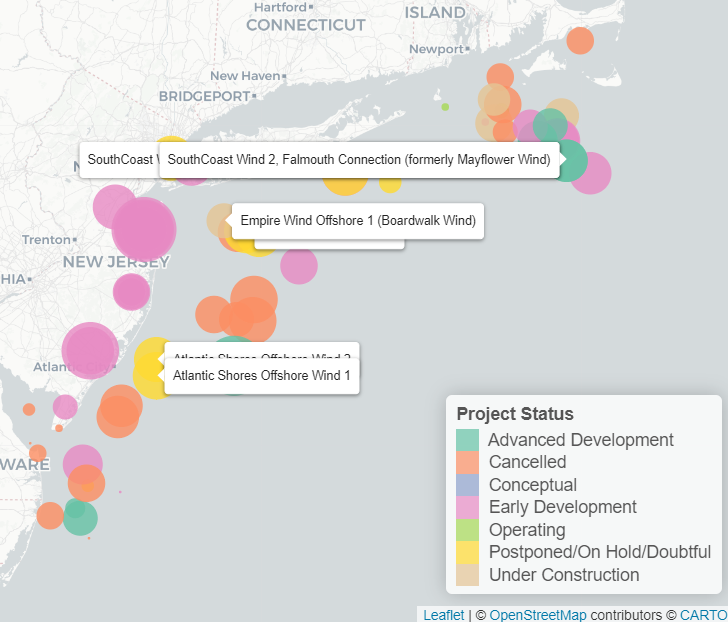
The risks to offshore wind are visible in the project pipeline. Infrastructure Insights™ tracks projects across the Northeast and Mid-Atlantic; The figure below shows their status by color and capacity. Notably, Atlantic Shores (NJ), SouthCoast (MA), and Empire Wind (NY) are all delayed, downsized, or canceled following federal freezes and permitting challenges.
Want to learn more about energy market trends and drivers?
Meet the Author