

Yes Energy Demand Forecasts Help Improve Day-Ahead Trading for Arizona Public Service


Customer APS is the largest electric utility in Arizona. It's the principal subsidiary of the investor-owned utility Pinnacle West Capital. With 9,400 MW of generating capacity, APS serves more than one million customers in 11 counties throughout the state.

Background A further rise in solar capacity is expected over the coming years, making it especially important to have accurate forecasts on inclement weather days, something that APS recognized early.

Results With Yes Energy Demand Forecasts, APS now benefits from a strong baseline on days with inclement weather. The utility can also now proactively manage demand drops during monsoon season with the Temperature Sensitivity tool, improving response to sudden temperature fluctuations.
Project Information
With an average of more than 300 days of sunshine a year, solar generation, both utility scale and rooftop PV, comprises a large part of Arizona’s generation mix.
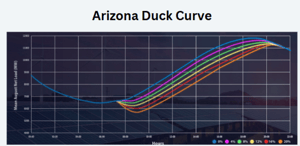
Significant challenges occur when cloudy weather limits the amount of energy generated by rooftop systems, especially during monsoon season. From APS’ perspective, power generation from rooftop PV is essentially negative demand, contributing to the duck curve in APS’ daily load profile.

Temperature Sensitivity
During monsoon season in the southwest US, temperatures can drop by 0-30° Fahrenheit (~0-17° Celsius) within an hour. Yes Energy expanded the Temperature Sensitivity feature for APS, so they can see the effect of a -15° F (~-8° C) temperature deviation from the forecast.
Forecast Vendor Selection
APS utilizes multiple load forecasts. Their web application helps traders with forecast contrast and selection by displaying both the Artificial Neural Network Short Term Load Forecast (ANNSTLF) and Yes Energy Demand Forecasts.
Ready to See What Yes Energy Can Do for Your Business?